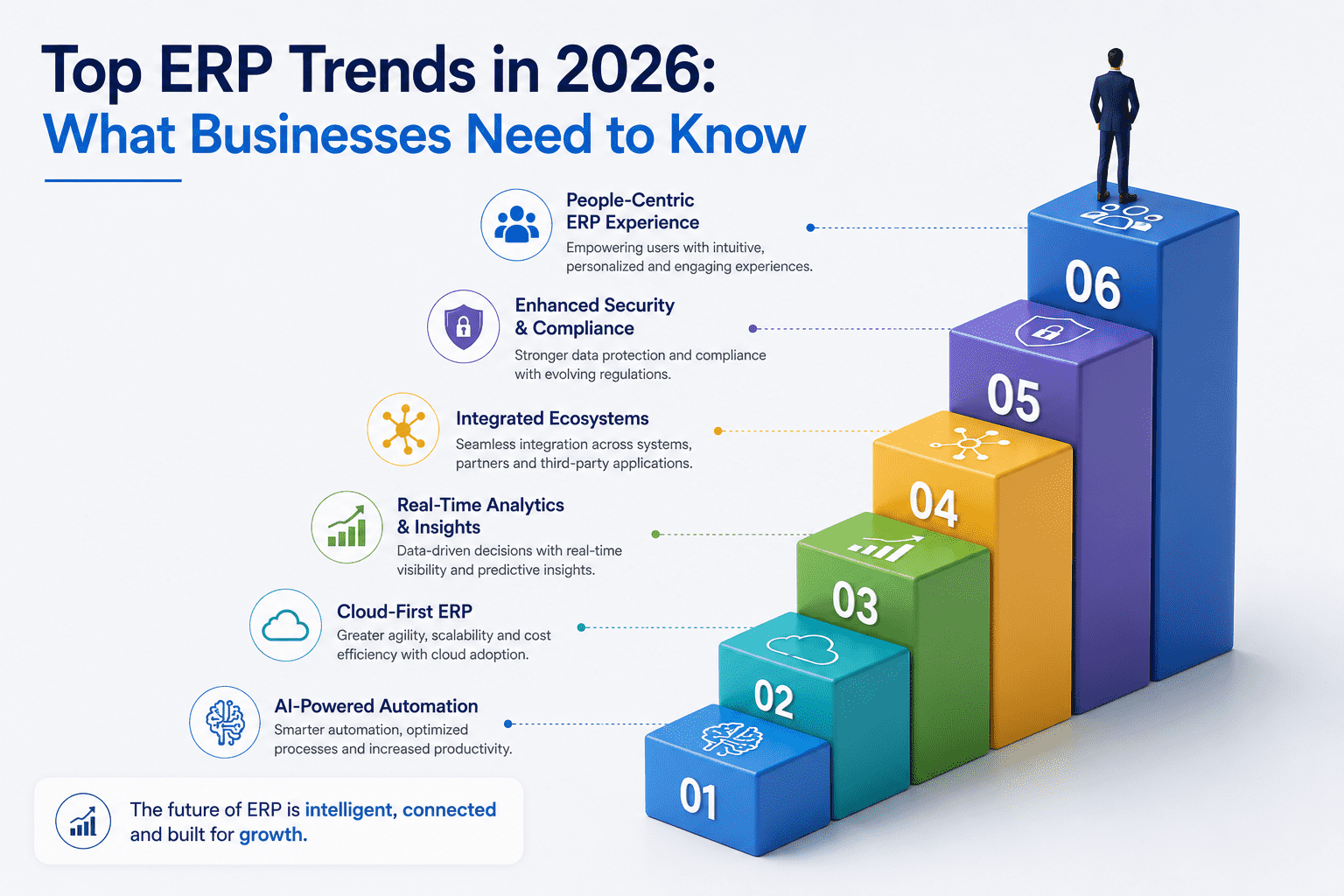
Top ERP trends in 2026: What businesses need to know
Enterprise resource planning (ERP) systems have evolved far beyond their traditional role of managing back-office operations. Today, ERP platforms serve as the digital foundation of modern organizations, connecting departments, streamlining workflows and enabling data-driven decision-making.
As technology continues to advance, businesses must stay informed about developments shaping the ERP landscape. Understanding the ERP trends in 2026 helps organizations improve efficiency, increase agility and prepare for future growth.
Why ERP trends in 2026 matter
Businesses operate in an increasingly competitive and fast-changing environment. Customers expect faster service, supply chains are more complex and organizations need real-time visibility into their operations.
The most impactful ERP Trends in 2026 reflect growing demand for intelligent, connected, and scalable business systems. Companies that adopt these trends can improve productivity, reduce costs and strengthen strategic decision-making.
1. Artificial intelligence becomes a core ERP capability
Artificial intelligence (AI) is transforming ERP systems from basic data platforms into intelligent business engines. Modern ERP solutions now automate tasks, detect patterns and deliver actionable insights.
- Improve demand forecasting
- Optimize inventory management
- Automate data entry and reporting
- Enhance financial planning
- Identify operational risks
AI integration remains one of the most influential ERP Trends in 2026, enabling faster and more accurate decision-making.
2. Cloud ERP continues to drive adoption
Cloud technology remains central to ERP modernization. Organizations are moving away from on-premise systems toward cloud-based ERP platforms that offer scalability and flexibility.
- Lower infrastructure costs
- Faster software updates
- Remote accessibility
- Enhanced collaboration
- Improved business continuity
3. Automation expands across business processes
ERP systems are becoming the backbone of automation initiatives. Businesses are automating workflows to reduce errors, accelerate processes and improve operational efficiency.
- Procurement workflows
- Invoice processing
- Order management
- Inventory replenishment
- Customer service operations
4. Real time analytics becomes essential
Leaders require immediate access to accurate data. Modern ERP platforms now deliver real-time dashboards, predictive analytics and performance monitoring.
Real-time intelligence is one of the defining ERP trends in 2026, allowing faster responses to operational changes.
5. Predictive planning improves decision making
ERP platforms are moving beyond historical reporting. Predictive analytics help organizations forecast demand, optimize inventory, plan production and allocate resources proactively.
6. Enhanced security and compliance capabilities
With increasing data volumes, security remains a top priority. ERP vendors are strengthening platforms with advanced protection and compliance tools.
- Role-based access controls
- Multi-factor authentication
- Automated audit trails
- Compliance monitoring
- Data encryption
7. Seamless integration across business systems
Modern ERP platforms integrate seamlessly with other business applications, eliminating data silos and improving information flow.
- CRM platforms
- eCommerce solutions
- Manufacturing systems
- Business intelligence tools
- Third-party applications
8. Industry-Specific ERP Solutions Gain Momentum
Organizations increasingly adopt ERP platforms tailored to their industries, offering specialized workflows and regulatory support.
- Manufacturing
- Distribution
- Retail
- Healthcare
- Professional services
9. ERP Supports Broader Digital Transformation Goals
ERP systems now act as strategic platforms that support enterprise-wide digital transformation. They connect people, processes, and technologies across the organization.
Looking Ahead
The future of ERP is intelligent, automated, and connected. The most important ERP Trends in 2026 highlight the growing role of AI, cloud computing, automation, analytics, and integration.
Organizations that invest in modern ERP capabilities will be better positioned to adapt, innovate, and achieve sustainable growth in an increasingly competitive landscape.