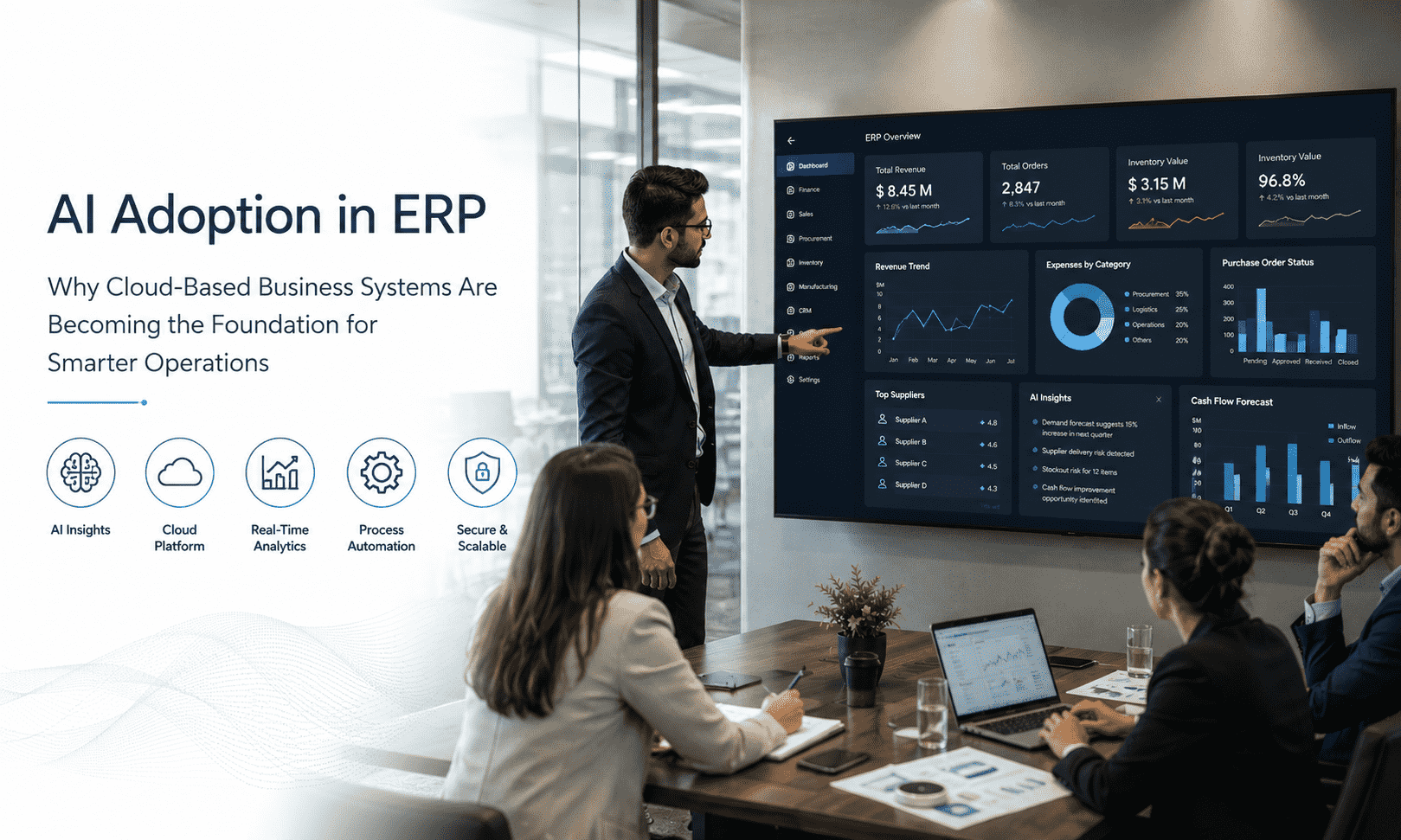
AI Adoption in ERP: Why Cloud-Based Business Systems Enable Smarter Operations
Artificial intelligence is no longer a future technology limited to innovation labs. It has become a practical business tool that helps organizations improve productivity, streamline operations, and make faster decisions.
Despite growing investment in AI, many businesses struggle to move from experimentation to measurable business impact.
Key takeaway:
Successful AI adoption in ERP requires a connected,
cloud-based foundation where data,
processes,
and people work together seamlessly.
Why businesses are rethinking their AI strategy
Many organizations began their AI journey by testing standalone applications such as chatbots, analytics tools, and automation platforms.
However, disconnected systems and fragmented data quickly limited AI effectiveness. When inventory, customer, and financial data exist in silos, AI lacks the context needed to deliver accurate insights.
AI adoption in ERP takes a different approach by embedding intelligence directly into systems that manage daily operations.
The role of cloud ERP in modern business operations
Traditional ERP systems focused primarily on recording transactions and standardizing processes.
Modern cloud ERP platforms act as connected business ecosystems, bringing together finance, procurement, inventory, sales, supply chain, customer management, and reporting in a single environment.
This structure creates the ideal foundation for AI adoption in ERP because AI depends on consistent, high-quality, and accessible data.
Unified data enables AI success
Fragmented data is one of the biggest barriers to digital transformation. Cloud ERP solves this challenge by creating a single source of truth across the organization.
With unified data, AI can analyze trends, forecast demand, and support better business decisions using real-time information.
Intelligent automation with AI
ERP platforms already automate purchasing, inventory management, invoicing, and financial reporting.
When AI is added, automation evolves from rule-based execution to intelligent decision-making.
- Predicting inventory shortages
- Recommending optimal purchasing quantities
- Detecting unusual financial transactions
- Prioritizing customer opportunities
- Identifying supplier delivery risks
- Automating exception management
Real-time insights for faster decisions
Cloud ERP systems with embedded AI continuously analyze operational data and deliver real-time insights to business leaders.
This enables organizations to identify risks, cost increases, margin changes, and operational bottlenecks as they emerge rather than after the fact.
Why trading and distribution businesses benefit most
Trading and distribution businesses operate in highly dynamic environments where efficiency directly impacts profitability.
AI adoption in ERP enables predictive operations such as:
- Demand-driven inventory replenishment
- Early supplier risk detection
- Proactive sales opportunity identification
- Automated cash flow forecasting
- Operational bottleneck prevention
These capabilities improve resilience, profitability, and long-term scalability.
The future of AI-powered business management
The focus is shifting from whether AI should be adopted to how it can be embedded into everyday business processes.
Cloud ERP platforms will increasingly deliver built-in AI capabilities across finance, inventory, procurement, customer service, forecasting, and strategic planning.
How Axiever supports AI-ready ERP transformation
At we believe successful AI adoption in ERP starts with a strong operational foundation.
Our cloud-based business management solution helps trading and distribution companies:
- Unify business data
- Automate core workflows
- Improve real-time visibility
- Eliminate operational silos
- Enable intelligent, data-driven decisions
- Prepare for advanced AI capabilities
Conclusion
The future of business technology is not defined by AI alone, but by how effectively AI is combined with connected systems, reliable data, and scalable operations.
AI adoption in ERP is becoming a strategic priority for organizations seeking smarter decisions, greater efficiency, and sustainable growth.