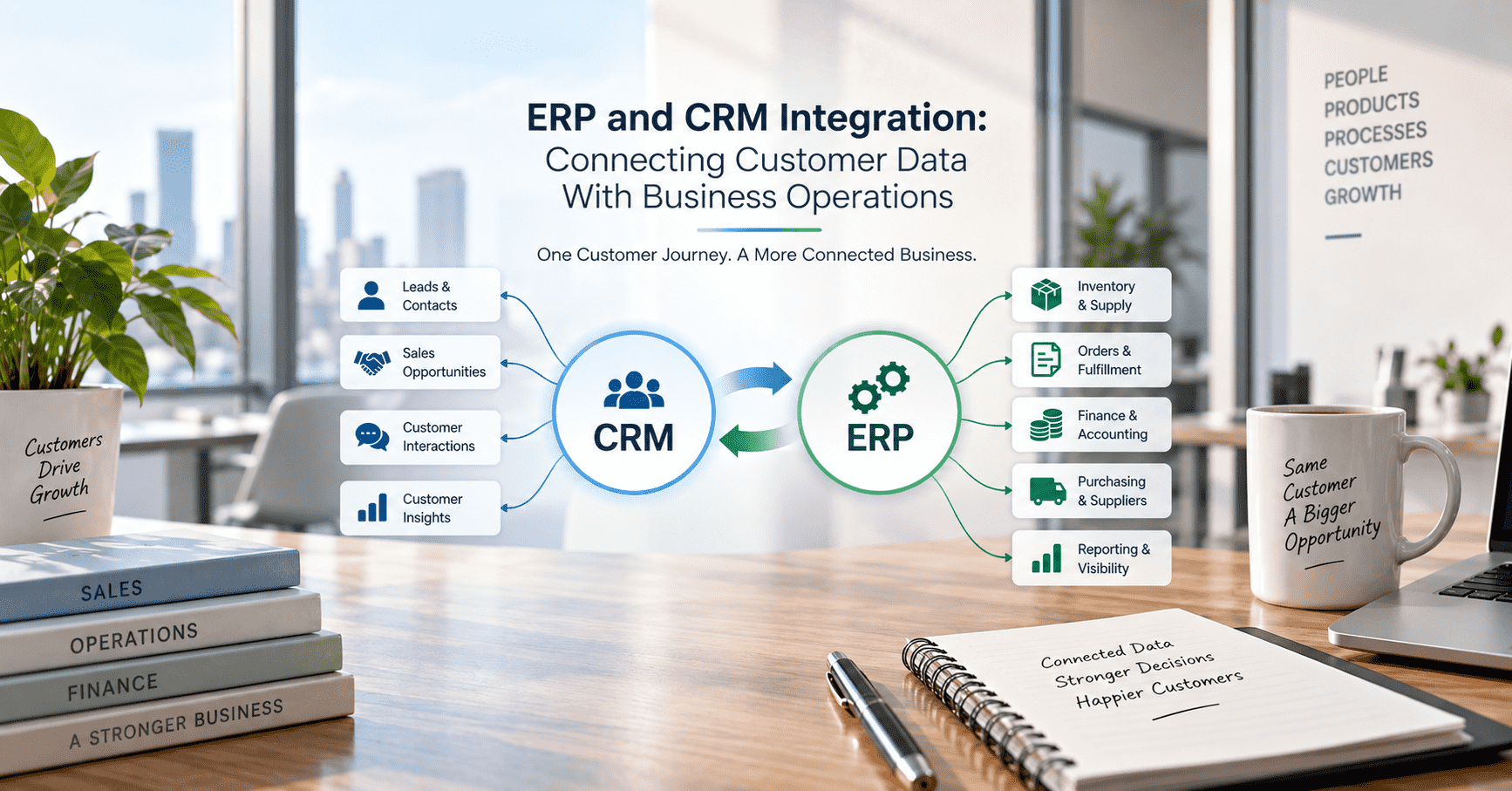
ERP and CRM Integration: Connecting Customer Data With Business Operations
Businesses rarely operate through one department or one system. Sales manages customer relationships, finance manages transactions, operations manages orders and inventory, while management needs visibility across everything.
The challenge begins when these functions work with disconnected information.
A sales team may know what a customer wants but not whether the required inventory is available. Finance may know whether an invoice has been paid but have limited visibility into the customer's latest interactions. Operations may have order information without seeing the complete customer history.
ERP and CRM integration connects these areas so customer information and operational data can work together.
Instead of treating sales, inventory, orders, finance, and customer management as separate processes, businesses can create a more continuous flow of information from the first customer interaction through the completed transaction.
What Is ERP and CRM Integration?
A CRM is primarily focused on customer relationships. It helps businesses manage leads, customer records, sales opportunities, communication, follow-ups, and sales activities.
An ERP focuses more heavily on business operations, including:
- Inventory and supply
- Finance and accounting
- Orders
- Purchasing
- Suppliers
- Documents
- Reporting
ERP and CRM integration connects these two sides of the business.
For example, a qualified lead can become a customer, a customer can receive a quotation, and an approved quotation can become a sales order. That order can then connect with inventory, fulfillment, invoicing, and payment processes.
The purpose is not simply to make two systems exchange data. It is to create a connected business workflow.
Why Connected Business Data Matters
When information is stored in separate systems, employees often become the connection between them.
A salesperson may need to contact the warehouse to confirm stock. Finance may need to check with sales to understand a customer transaction. Customer service may need to contact several departments to find an order update.
This creates additional work and slows down information flow.
With ERP and CRM integration, relevant information can move between customer-facing and operational processes without requiring employees to repeatedly recreate the same information.
This can help businesses reduce:
- Duplicate data entry
- Manual information sharing
- Spreadsheet dependency
- Delays between departments
- Inconsistent customer records
The bigger advantage is that teams can work with more complete business context.
Connecting Sales With Inventory
Sales commitments should be based on what the business can actually deliver.
Consider a customer requesting a large quantity of a product. The salesperson needs more than the customer's contact information. They may also need to know current stock, existing commitments, expected replenishment, and potential delivery timelines.
When customer and inventory information are separated, getting this information can require several checks.
ERP and CRM integration can bring these areas closer together, allowing customer demand to be viewed alongside operational information.
This is especially relevant for trading and distribution businesses where sales, inventory, purchasing, and fulfillment are closely connected.
A customer order is not simply a sales event. It can affect multiple areas of the business.
Reducing Repetitive Data Entry
Disconnected systems often result in the same information being entered multiple times.
A customer may first be created in a CRM. When that customer places an order, information may need to be recreated in an ERP. Finance may then require additional updates.
This process consumes employee time and increases the possibility of inconsistent information.
A connected environment allows relevant information to move through the workflow.
For example:
- Customer → Quotation → Sales Order → Inventory → Invoice → Payment
Once information is captured at one stage, it can support the next stage instead of being manually recreated.
The goal is simple: employees should spend more time using information and less time moving it between systems.
Improving the Customer Experience
Customers do not experience a business as separate departments.
They expect sales, operations, finance, and customer service to understand the same situation.
If a customer asks about an order, the employee may need to know its status, delivery information, invoice details, payment status, and previous interactions.
Without connected information, finding these details can take time.
With ERP and CRM integration, customer-facing teams can work with more relevant operational context.
This can make customer conversations more informed and reduce the need for customers to repeat information they have already provided.
Creating Better Business Visibility
Management needs more than a sales pipeline.
A growing pipeline is useful, but leaders also need to understand whether the business has the inventory, operational capacity, and financial processes required to support that demand.
Connecting CRM and ERP information can provide a broader view of relationships between:
- Sales activity and orders
- Customer demand and inventory
- Orders and revenue
- Sales and collections
- Customers and purchasing patterns
This makes business information more useful for planning and decision-making.
Instead of looking at isolated reports, management can understand how different parts of the business influence one another.
Turning Integration Into Automation
Integration creates the connection between systems. Automation can make that connection more useful.
Businesses can automate repetitive activities such as lead assignment, follow-up tasks, quotation workflows, order processing, notifications, and invoice-related processes.
For example:
- New lead → Qualification → Customer → Quotation → Order → Fulfillment → Invoice
The exact workflow depends on the business, but the principle remains the same.
Automation should remove repetitive administrative work while keeping important processes visible to the people responsible for them.
This is where ERP and CRM integration becomes part of a broader business automation strategy rather than simply a technical connection.
Why It Matters for Trading and Distribution
Trading and distribution businesses often manage complex relationships between customers, suppliers, inventory, orders, warehouses, and finance.
A single customer order can influence several departments.
If a product is unavailable, sales needs to know. Procurement may need to source it. Inventory needs to be updated. The customer needs a realistic delivery expectation. Finance eventually needs to process the resulting transaction.
When these processes operate independently, communication becomes increasingly important—and increasingly difficult as the business grows.
An integrated environment can connect these activities and provide a more consistent flow of information.
How Axiever Connects CRM and ERP
Axiever is designed around a connected business management approach rather than treating CRM as an isolated sales application.
The platform brings together Customer & CRM, Order Management, Inventory & Supply, Finance & Accounting, Suppliers & Vendors, and other core business functions.
This allows customer information to remain connected with the operational processes that follow.
A sales opportunity can move toward a quotation. A quotation can become an order. An order can connect with inventory and fulfillment. The resulting transaction can move into finance.
Axiever also supports integrations with external business applications, helping businesses connect their existing tools and workflows.
For trading and distribution companies, this connected approach can be particularly useful because customer relationships and operational processes are closely linked.
Building a More Connected Business
The value of ERP and CRM integration is not simply that two systems can exchange information.
The real value comes from connecting the processes behind that information.
When customer management, sales, inventory, orders, finance, and automation work together, employees spend less time searching for information and more time acting on it.
For growing businesses, the objective should not be to keep adding disconnected tools.
It should be to create a business environment where information flows naturally between the people and processes that need it.
Axiever brings CRM, ERP, automation, inventory, orders, finance, supplier management, and other business functions into one connected platform—helping businesses move from fragmented information toward a more unified way of working.