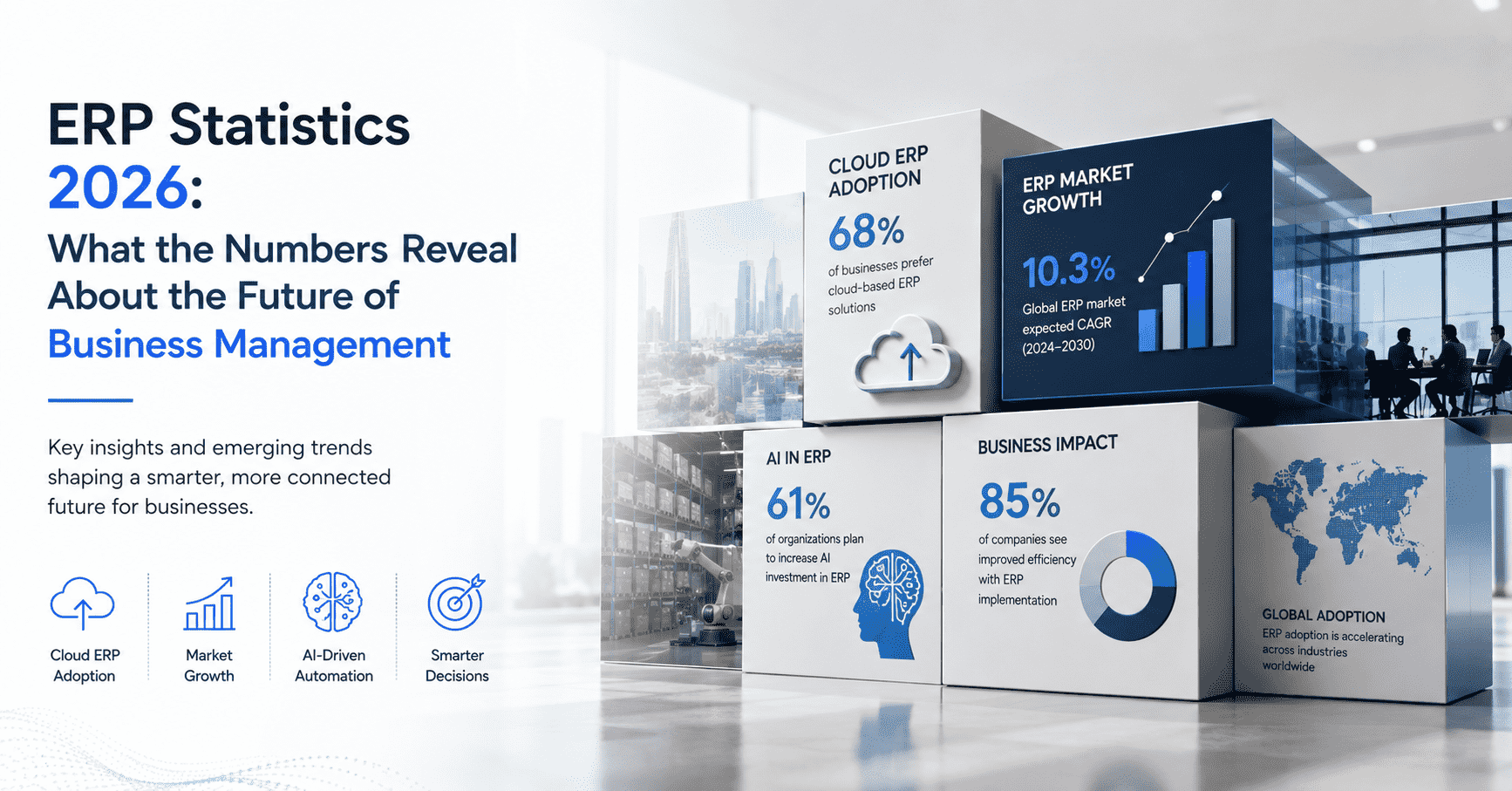
ERP statistics 2026: What the numbers reveal about the future of business management
Business leaders have access to more technology than ever before, yet many still struggle with fragmented data, disconnected processes, and limited operational visibility.
As organizations pursue efficiency and scalability, Enterprise Resource Planning systems are becoming central to digital transformation strategies.
Key insight:
ERP statistics reveal a clear shift
toward cloud platforms,
AI-driven automation,
and integrated business management.
ERP is no longer a back-office tool
One of the most important ERP statistics emerging from recent research is the changing role of ERP.
Organizations increasingly view ERP not as transactional software, but as a strategic foundation for operational excellence and business agility.
As businesses grow, they encounter challenges such as duplicate data entry, delayed reporting, inventory inaccuracies, and disconnected workflows.
Modern ERP platforms address these issues by creating a unified environment where departments work from the same real-time information.
For trading and distribution businesses, this means improved inventory visibility, faster order processing, stronger supplier coordination, and better financial control.
The ERP market continues to expand
Current ERP statistics show strong and sustained growth in global ERP adoption.
Organizations across industries are increasing ERP investments as they prioritize automation, digital transformation, and operational efficiency.
This expansion reflects a shift away from isolated applications toward integrated platforms that support end-to-end processes.
Key drivers behind ERP market growth
- Rising operational complexity
- Growing customer expectations
- Expansion of global supply chains
- Demand for real-time insights
- Increased focus on productivity
These factors are pushing organizations of all sizes to modernize their technology foundations.
Cloud ERP is becoming the preferred choice
One of the most consistent ERP statistics across industry reports is the rapid adoption of cloud ERP.
What was once an emerging option has become the preferred deployment model for many organizations worldwide.
Cloud ERP eliminates the need for complex infrastructure management while providing enterprise-grade capabilities.
Why businesses are choosing cloud ERP
- Faster implementation timelines
- Lower infrastructure and maintenance costs
- Improved scalability
- Automatic security updates
- Remote and multi-location access
- Simpler system integrations
For organizations operating across multiple warehouses or locations, cloud ERP delivers the visibility required to manage operations efficiently.
AI is reshaping ERP capabilities
Another major trend highlighted by ERP statistics is the growing role of artificial intelligence.
Modern ERP systems are no longer limited to recording transactions.
AI-enabled ERP platforms analyze patterns, detect anomalies, and generate insights that support better decisions.
How businesses are using AI in ERP
- Forecasting inventory demand
- Predicting purchasing requirements
- Improving financial planning
- Identifying operational risks
- Automating repetitive tasks
- Delivering actionable insights
These capabilities allow organizations to move from reactive to proactive business management.
ERP implementation success requires strategy
While adoption continues to rise, ERP statistics also highlight a critical lesson.
Technology alone does not guarantee success.
Many ERP initiatives fail due to poor planning, unclear objectives, weak change management, or limited user adoption.
Common factors behind successful ERP projects
- Clearly defined business goals
- Standardized and optimized processes
- Strong user training and adoption
- Experienced implementation partners
These elements consistently appear in organizations that achieve strong ERP ROI.
Why trading and distribution businesses are accelerating adoption
ERP statistics show that trading and distribution businesses remain among the fastest ERP adopters.
These organizations depend on tight coordination between inventory, procurement, suppliers, customers, and finance.
Without integrated systems, inefficiencies quickly impact profitability.
ERP benefits for distribution-focused organizations
- Real-time inventory tracking
- Improved order accuracy
- Supplier performance visibility
- Reduced manual processes
- Streamlined procurement workflows
- Stronger financial control
Business automation is driving ERP investment
One of the strongest ERP statistics trends is the growing link between ERP adoption and automation initiatives.
Organizations are investing in ERP not just to manage data, but to automate workflows.
Processes commonly automated through ERP
- Purchase approvals
- Invoice processing
- Inventory replenishment
- Document management
- Financial reconciliations
- Reporting and notifications
Automation reduces errors, improves efficiency, and enables teams to focus on higher value work.
ERP as the core of digital transformation
ERP statistics increasingly show ERP systems acting as the central platform for digital transformation.
Modern ERP connects technologies such as:
- Artificial intelligence
- Robotic process automation
- Business intelligence
- Customer relationship management
- Document management systems
- Supply chain solutions
This integration creates a connected business environment with real-time visibility and stronger operational control.
What these ERP statistics mean for business leaders
The message behind today’s ERP statistics is clear.
Organizations that adopt integrated business platforms are positioning themselves for long-term success.
Businesses that continue relying on disconnected systems risk falling behind competitors using automation and analytics.
Key priorities shaping ERP investment
- Operational efficiency
- Process automation
- Data-driven decisions
- Scalable technology foundations
- Improved customer experiences
- Enhanced financial visibility
Final thoughts
ERP statistics reveal more than market growth trends.
They highlight a fundamental shift in how businesses manage operations, make decisions, and drive performance.
As cloud adoption accelerates, AI capabilities expand, and automation becomes essential, ERP systems are evolving into complete business management platforms.
At we believe ERP should do more than manage transactions.
It should deliver visibility, automation, and intelligence that help businesses compete in a rapidly changing environment.
The organizations acting on these ERP statistics today will be the ones leading their industries tomorrow.