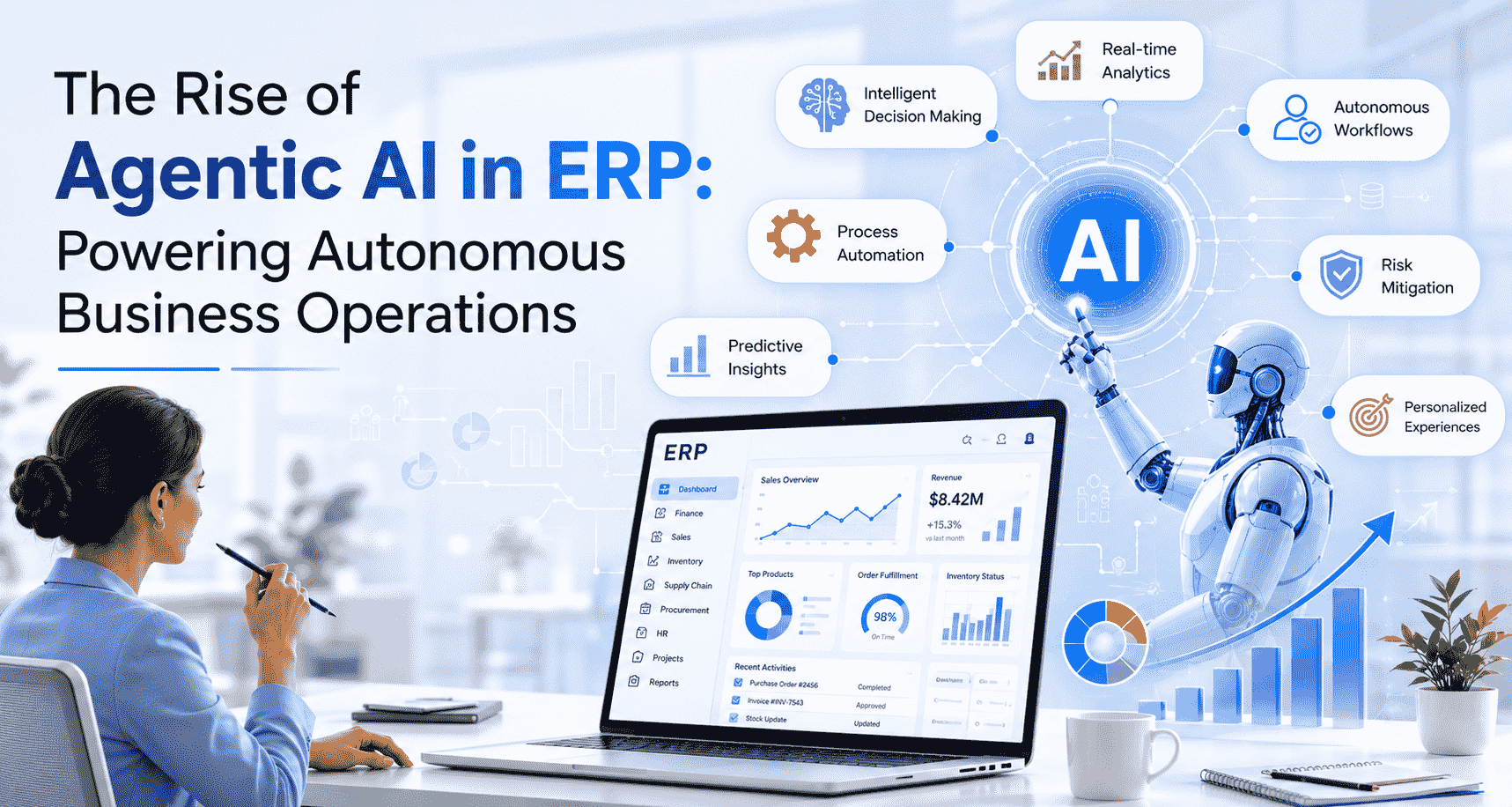
The rise of agentic AI in ERP: Powering autonomous business operations
Enterprise resource planning (ERP) systems have evolved from simple record-keeping tools into powerful platforms that connect finance, procurement, inventory, manufacturing, supply chains, and customer operations. However, as businesses generate more data and face increasing operational complexity, traditional automation is no longer sufficient.
Organizations today need systems that can do more than process information. They need platforms that can understand situations, make informed decisions, and take action. Agentic AI in ERP is reshaping the future of enterprise technology by combining intelligence with autonomy to streamline operations, improve responsiveness, and reduce reliance on manual processes.
Key takeaway:
Agentic AI transforms ERP from reactive automation
into an autonomous system of intelligent action.
What is agentic AI in ERP?
Agentic AI in ERP refers to the use of autonomous AI agents within ERP systems to perform tasks, make decisions, and execute workflows with minimal human intervention.
Unlike conventional automation, which follows predefined rules, AI agents can adapt to changing conditions, learn from data, and continuously optimize outcomes across enterprise operations.
How autonomous ERP operations work
Autonomous ERP operations rely on intelligent agents that continuously monitor business activities, analyze operational data, and take action when required. These agents operate across departments, helping organizations improve efficiency and accelerate decision-making.
Business impact of agentic AI in ERP
Organizations adopting agentic ERP capabilities report improvements in operational efficiency, decision speed, and workflow consistency. Autonomous ERP enables proactive execution rather than reactive problem-solving.
Key benefits of agentic AI in ERP
Increased operational efficiency
By automating repetitive and time-consuming tasks, businesses reduce administrative workloads and allow employees to focus on strategic initiatives that drive growth.
Faster decision-making
AI-powered ERP systems process large volumes of data in real time, enabling organizations to respond quickly to opportunities and operational challenges.
Improved accuracy
Autonomous execution minimizes human error and ensures consistent outcomes across enterprise processes.
Greater business agility
Intelligent workflows help organizations adapt to market changes, customer expectations, and supply chain disruptions with greater speed and confidence.
Agentic AI across ERP functions
Procurement and inventory management
AI agents monitor stock levels, forecast demand, identify procurement requirements, and automate purchasing decisions, reducing shortages and maintaining optimal inventory.
Finance and accounting
Autonomous ERP capabilities validate transactions, streamline reconciliations, detect anomalies, and generate reports with improved speed and accuracy.
Supply chain operations
Intelligent ERP systems analyze supplier performance, logistics data, and inventory movement to improve planning and operational resilience.
Manufacturing operations
Manufacturers use agentic capabilities to monitor production schedules, allocate resources efficiently, and identify bottlenecks before they impact productivity.
Customer service
ERP-connected AI agents access customer information, track orders, and resolve routine inquiries without manual intervention, improving response times and customer satisfaction.
Challenges of adopting Agentic AI
While the benefits are substantial, successful implementation requires careful planning and organizational readiness.
- Data quality and accuracy
- Governance and decision oversight
- Security and compliance requirements
- Workforce training and change management
Organizations that succeed treat Agentic AI adoption as a business transformation initiative, not just a technology upgrade.
Future of enterprise operations
The future of ERP extends far beyond automation. Businesses are seeking systems that can anticipate challenges, coordinate actions, and continuously improve performance.
Agentic AI in ERP enables this evolution by creating intelligent, autonomous systems that support long-term agility and competitive advantage.
Conclusion
The rise of Agentic AI in ERP represents a significant shift in enterprise technology. By combining intelligent decision-making with autonomous execution, organizations can improve efficiency, agility, and operational resilience.
From procurement and finance to manufacturing and customer service, agentic ERP capabilities are powering the next generation of autonomous business operations in an increasingly digital economy.