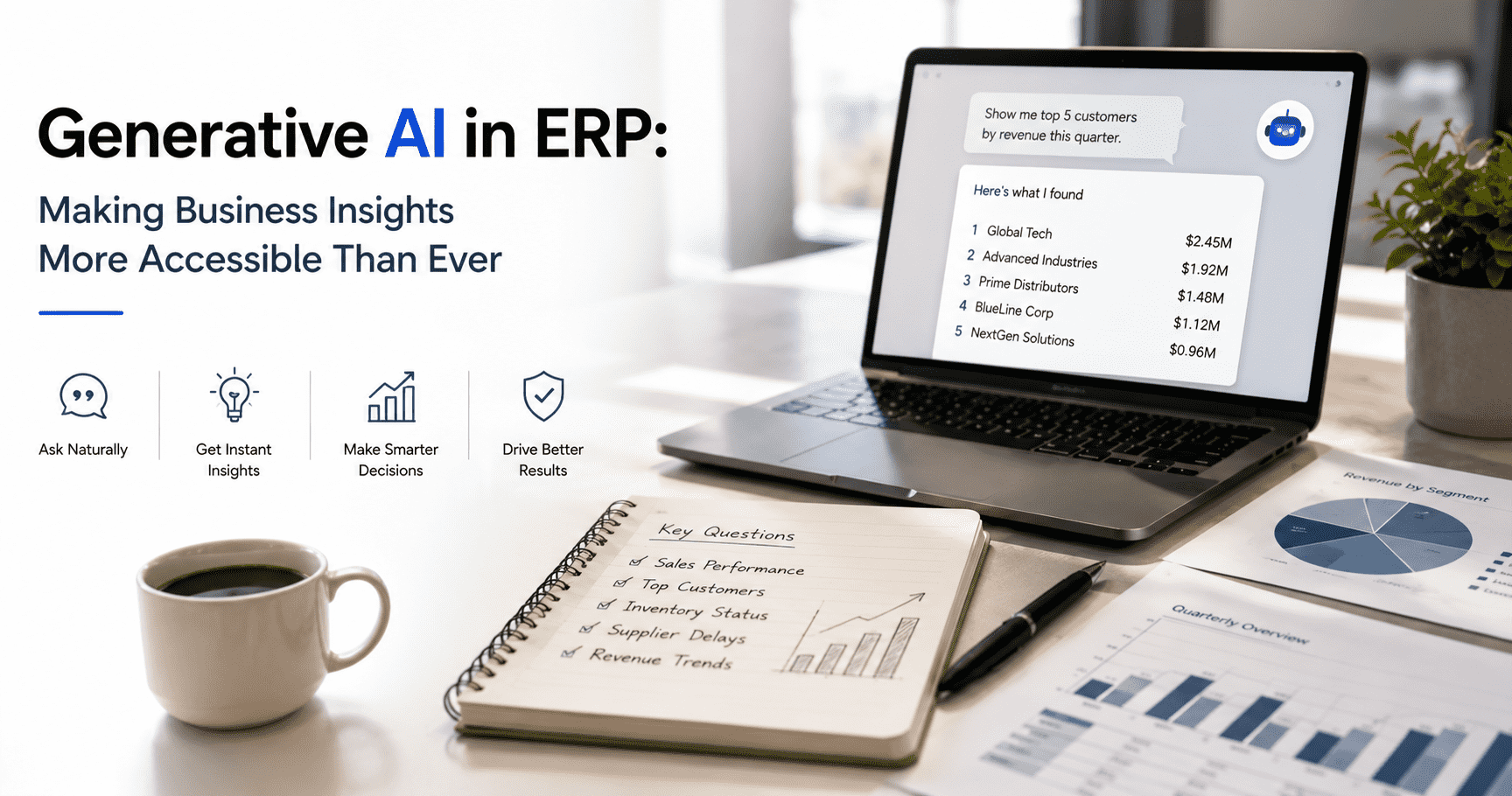
Generative AI in ERP: Making business insights more accessible than ever
Enterprise resource planning systems have long served as the backbone of modern business operations.
Yet despite the value of ERP data, accessing meaningful insights has often required complex reports, dashboards, and specialist support.
Key insight:
Generative AI in ERP is transforming
how users interact with data,
shifting reporting
from dashboards
to natural conversations.
From reports to conversations
For most organizations, collecting data has never been the problem.
The real challenge has been turning that data into timely, actionable decisions.
Traditional ERP systems rely heavily on predefined reports and complex filtering.
Generative AI in ERP introduces a more intuitive approach by allowing users to ask questions in natural language.
Examples of conversational ERP queries
- Which customers generated the highest revenue this quarter?
- Which products show declining demand?
- What inventory items risk stock-outs?
- Which suppliers have the longest lead times?
Instead of navigating dashboards, users receive clear answers in seconds.
Why ERP is the ideal foundation for AI
Artificial intelligence is only as effective as the data it can access.
ERP systems contain the most structured and business-critical information within an organization.
Core ERP data powering AI insights
- Financial transactions
- Procurement records
- Inventory movements
- Customer orders
- Supplier performance
- Sales activities
- Operational workflows
This enables Generative AI in ERP to deliver insights grounded in real business context, not isolated data points.
Making business data accessible to everyone
Historically, business intelligence was limited to analysts and ERP specialists.
Generative AI in ERP removes this barrier by democratizing access to information.
Who benefits from AI-powered ERP access
- Finance teams reviewing cash flow summaries
- Procurement teams analyzing supplier trends
- Warehouse managers identifying inventory risks
- Sales leaders uncovering revenue opportunities
- Executives receiving instant performance snapshots
This empowers employees at every level to make faster, more confident decisions.
Emerging use cases for Generative AI in ERP
As adoption grows, organizations are discovering practical applications across daily operations.
High-impact ERP AI use cases
- Automated financial analysis and summaries
- Inventory optimization and demand insights
- Executive-level reporting and performance snapshots
- Improved forecasting and planning
- Enhanced operational visibility
These use cases help organizations move from reactive to proactive management.
The foundation still matters: data quality
While AI capabilities continue to evolve, success depends on strong data foundations.
Essential requirements for reliable AI insights
- Accurate and consistent data
- Standardized business processes
- Effective data governance
- Strong security controls
- Well-integrated systems
Without these fundamentals, AI-generated insights risk losing relevance and trust.
What business leaders should expect next
The future of ERP is not just automation.
It is accessibility.
Generative AI in ERP allows technology to adapt to users, rather than forcing users to adapt to technology.
This shift accelerates decision-making, improves collaboration, and strengthens business agility.
Final thoughts
Generative AI in ERP represents a major evolution in how businesses engage with data.
By enabling conversational access to insights, ERP systems are transforming from passive record-keepers into active decision partners.
At :contentReference[oaicite:0]{index=0}, we believe ERP should do more than store information.
It should help organizations understand, act, and compete with confidence.
The next wave of ERP innovation will not just automate processes — it will make insights accessible to everyone who needs them.