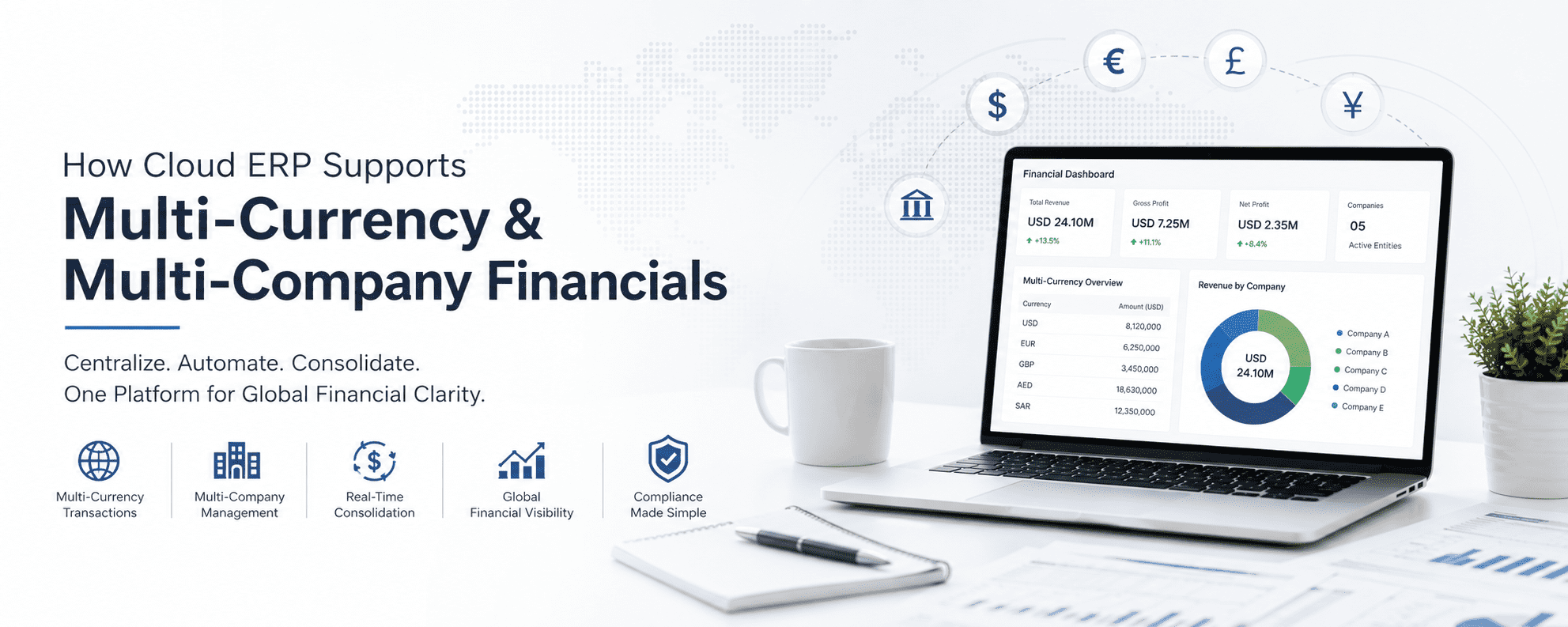
How cloud ERP supports multi-currency & multi-company financials
Introduction
As businesses expand into international markets, managing financial operations becomes increasingly complex. Different currencies, multiple legal entities, varying tax regulations, and intercompany transactions can quickly overwhelm traditional accounting systems. This is where Cloud ERP becomes a strategic asset. By centralizing financial management, Cloud ERP enables organizations to handle multi-currency transactions and multi-company financials with greater accuracy, efficiency, and visibility.
Whether you're a growing trading company, a distributor, or an enterprise operating across multiple countries, adopting Cloud ERP can simplify financial processes while supporting long-term business growth.
Why global businesses need cloud ERP
Business expansion often brings financial challenges that disconnected accounting software and spreadsheets cannot efficiently manage. Companies operating in multiple regions must deal with different currencies, separate financial books, local compliance requirements, and consolidated reporting.
A modern Cloud ERP platform brings these operations together into a single system, allowing finance teams to work with real-time data instead of manually reconciling information from multiple sources. This reduces administrative effort while improving financial accuracy and decision-making.
Managing multi-currency transactions with cloud ERP
International businesses regularly buy, sell, and receive payments in different currencies. Manual currency conversions increase the risk of accounting errors and inconsistent reporting.
With Cloud ERP, businesses can:
- Record transactions in the customer's or supplier's preferred currency.
- Automatically convert values into the company's base currency.
- Apply current or predefined exchange rates.
- Calculate realized and unrealized foreign exchange gains or losses.
- Generate accurate financial reports across multiple currencies.
By automating currency management, Cloud ERP helps finance teams reduce manual work while maintaining accurate financial records.
Simplifying multi-company financial management
Organizations with multiple subsidiaries or legal entities often struggle to maintain separate financial records while producing consolidated reports.
A robust cloud ERP solution allows each company to maintain its own:
- Chart of accounts
- Tax configuration
- Fiscal calendar
- Banking information
- Financial statements
- User access permissions
At the same time, corporate finance teams gain a consolidated view of every entity through a single platform, eliminating the need to combine reports manually.
Key benefits of cloud ERP for multi-currency & multi-company financials
Centralized financial visibility
One of the biggest advantages of Cloud ERP is having complete financial visibility across all business entities. Finance leaders can monitor revenues, expenses, cash flow, and profitability without switching between different accounting systems.
Real-time dashboards help executives make informed decisions using accurate and up-to-date financial information.
Automated currency management
Exchange rate fluctuations are unavoidable in global business. Instead of relying on manual calculations, Cloud ERP automatically updates exchange rates and applies them during transactions.
This improves reporting accuracy while significantly reducing accounting errors.
Faster financial consolidation
Preparing consolidated financial statements is often one of the most time-consuming responsibilities for finance teams.
Cloud ERP automates consolidation by combining financial information from multiple companies, eliminating duplicate entries, and simplifying group reporting. This allows organizations to shorten month-end closing cycles and improve reporting efficiency.
Seamless intercompany transactions
Businesses frequently transfer inventory, services, or operational costs between subsidiaries.
A modern ERP platform simplifies these transactions by automating:
- Intercompany invoices
- Cross-company journal entries
- Due-to and due-from accounts
- Financial reconciliation
This reduces duplication while improving financial transparency across the organization.
Improved regulatory compliance
Operating across different countries means complying with various accounting standards, tax regulations, and reporting requirements.
Cloud ERP allows businesses to configure company-specific tax rules while maintaining standardized financial processes throughout the organization. This helps reduce compliance risks and prepares businesses for audits with confidence.
Real-time financial reporting
Instead of waiting until the end of the month, finance teams can generate reports whenever needed.
These reports may include:
- Profit and Loss Statements
- Balance Sheets
- Cash Flow Reports
- Company-wise Profitability
- Consolidated Financial Reports
Real-time reporting enables faster strategic planning and improves overall financial control.
Why cloud ERP is better than traditional financial systems
Unlike conventional accounting software, Cloud ERP provides a centralized platform that connects finance, procurement, inventory, sales, and operations.
This integration offers several advantages:
- Access financial data from anywhere.
- Improve collaboration between multiple offices.
- Eliminate duplicate data entry.
- Reduce IT infrastructure costs.
- Scale easily as the business grows.
- Receive automatic software updates.
These capabilities make Cloud ERP an ideal solution for organizations planning regional or international expansion.
How Axiever helps businesses manage global financial operations
Managing complex financial operations requires more than accounting software. Businesses need an intelligent platform that connects every financial process while providing complete operational visibility.
Axiever's cloud-based business management solution is designed to help trading, distribution, and service-based organizations streamline financial management through automation and real-time insights.
With Axiever, businesses can:
- Manage multiple companies within a single ERP environment.
- Process transactions across multiple currencies.
- Automate exchange rate calculations.
- Simplify intercompany accounting.
- Generate consolidated financial reports.
- Monitor financial performance through real-time dashboards.
- Improve collaboration across departments and business entities.
By reducing manual effort and increasing financial accuracy, Axiever empowers organizations to scale confidently while maintaining complete control over their financial operations.
Best practices for implementing cloud ERP
To maximize the value of cloud ERP, businesses should:
- Standardize financial processes before implementation.
- Configure company-specific tax and compliance settings.
- Define a consistent chart of accounts across business entities.
- Train finance teams on multi-currency workflows.
- Regularly review exchange rate configurations.
- Use real-time dashboards for continuous financial monitoring.
Following these best practices helps organizations achieve faster adoption and better long-term performance.
Final thoughts
Managing multiple companies and currencies no longer needs to be a complicated process. With the right Cloud ERP, businesses can automate financial operations, improve reporting accuracy, simplify compliance, and gain complete visibility across every legal entity.
As organizations continue expanding into global markets, investing in Cloud ERP becomes essential for maintaining financial control and supporting sustainable growth. Whether your business is managing international customers, overseas suppliers, or multiple subsidiaries, a modern ERP platform provides the flexibility and intelligence needed to operate with confidence.
If you're looking to simplify multi-currency and multi-company financial management, Axiever Business Management Solution delivers the automation, visibility, and scalability your growing business needs. Explore more at https://axiever.com.