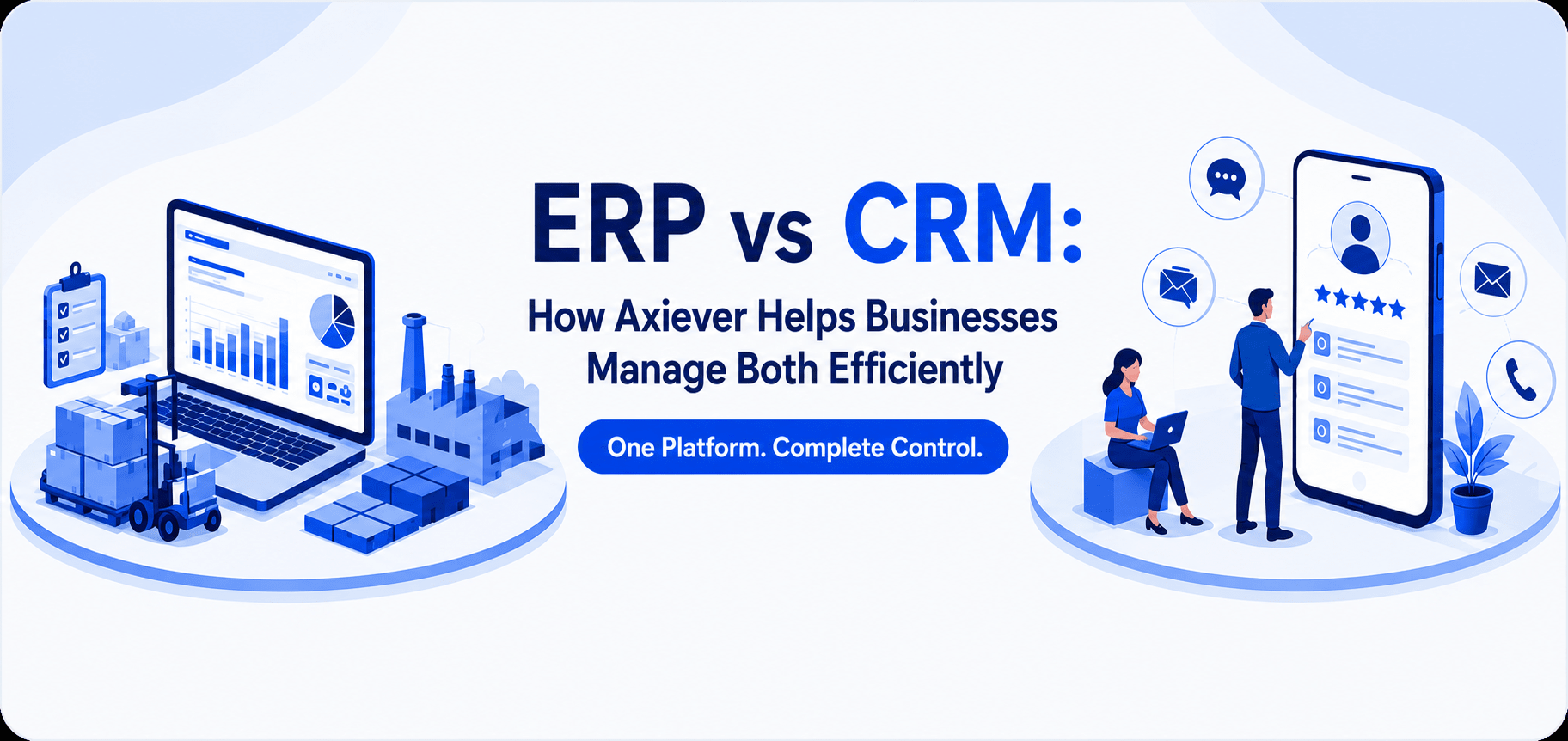
ERP vs CRM: How Axiever helps businesses manage both efficiently
Why modern businesses need connected systems
Businesses today need more than standalone software. They need connected systems that help teams work smarter, improve customer relationships, and manage operations without unnecessary complexity.
This is why ERP and CRM solutions have become essential for modern organizations looking to scale efficiently.
Reality:
Disconnected systems slow growth, reduce visibility, and increase manual work.
Understanding ERP and CRM
What is ERP?
ERP (Enterprise Resource Planning) focuses on managing core internal business operations, including:
- Finance and accounting
- Inventory management
- Procurement
- Supply chain operations
- Human resources
- Project management
The primary goal of ERP is to improve internal efficiency and automate operational workflows.
What is CRM?
CRM (Customer Relationship Management) helps businesses manage customer interactions and revenue-driving activities such as:
- Lead management
- Sales tracking
- Customer support
- Marketing automation
- Client communication
- Relationship management
While ERP manages operations, CRM focuses on improving customer experience and revenue growth.
The challenge with separate ERP and CRM systems
Many organizations still operate ERP and CRM platforms separately. This often leads to operational inefficiencies and poor visibility.
Common problems:
Data silos, duplicate data entry,
communication gaps,
delayed reporting,
and disconnected customer insights.
As businesses scale, managing disconnected systems becomes increasingly difficult and slows down growth.
How Axiever connects ERP and CRM
Provides integrated business solutions that unify operations, customer management, and business intelligence into one connected ecosystem.
Instead of switching between multiple tools, businesses can manage finance, operations, sales, workflows, customer interactions, and reporting from a centralized platform.
Result:
Better collaboration, real-time insights,
reduced manual work, and improved customer experiences.
ERP capabilities with Axiever
Axiever’s ERP solutions help organizations optimize day-to-day operations through automation and centralized management.
- Financial management
- Inventory and warehouse management
- Procurement workflows
- Project tracking
- Document management
- Workflow automation
- Operational reporting
- Resource planning
These capabilities improve productivity, accuracy, and operational visibility across departments.
CRM capabilities with Axiever
Axiever also strengthens customer relationships through intelligent CRM functionality.
- Lead and sales management
- Customer communication tracking
- Service request management
- Customer data management
- Sales pipeline visibility
- Automated follow-ups
- Performance reporting
With centralized customer information, businesses improve engagement, responsiveness, and customer satisfaction.
Benefits of an integrated ERP and CRM system
Unified business visibility
Gain a complete view of operations, finances, customers, and performance from one platform.
Improved team collaboration
Departments work more effectively with shared access to real-time information.
Faster decision-making
Integrated dashboards and analytics support quicker, data-driven decisions.
Increased efficiency
Automation reduces manual work, minimizes errors, and improves workflow efficiency.
Better customer experience
Teams respond faster and deliver more personalized customer interactions.
Why modern businesses choose integrated solutions
As businesses grow, operational complexity increases. Managing multiple disconnected systems becomes inefficient and difficult to scale.
Integrated ERP and CRM solutions from Axiever help businesses simplify operations, improve collaboration, and build a connected digital foundation.
Final thoughts
ERP and CRM are both critical for business success, but managing them separately creates unnecessary complexity.
With integrated solutions from Axiever, organizations can unify operations, streamline workflows, improve customer engagement, and drive smarter business decisions through one connected platform.