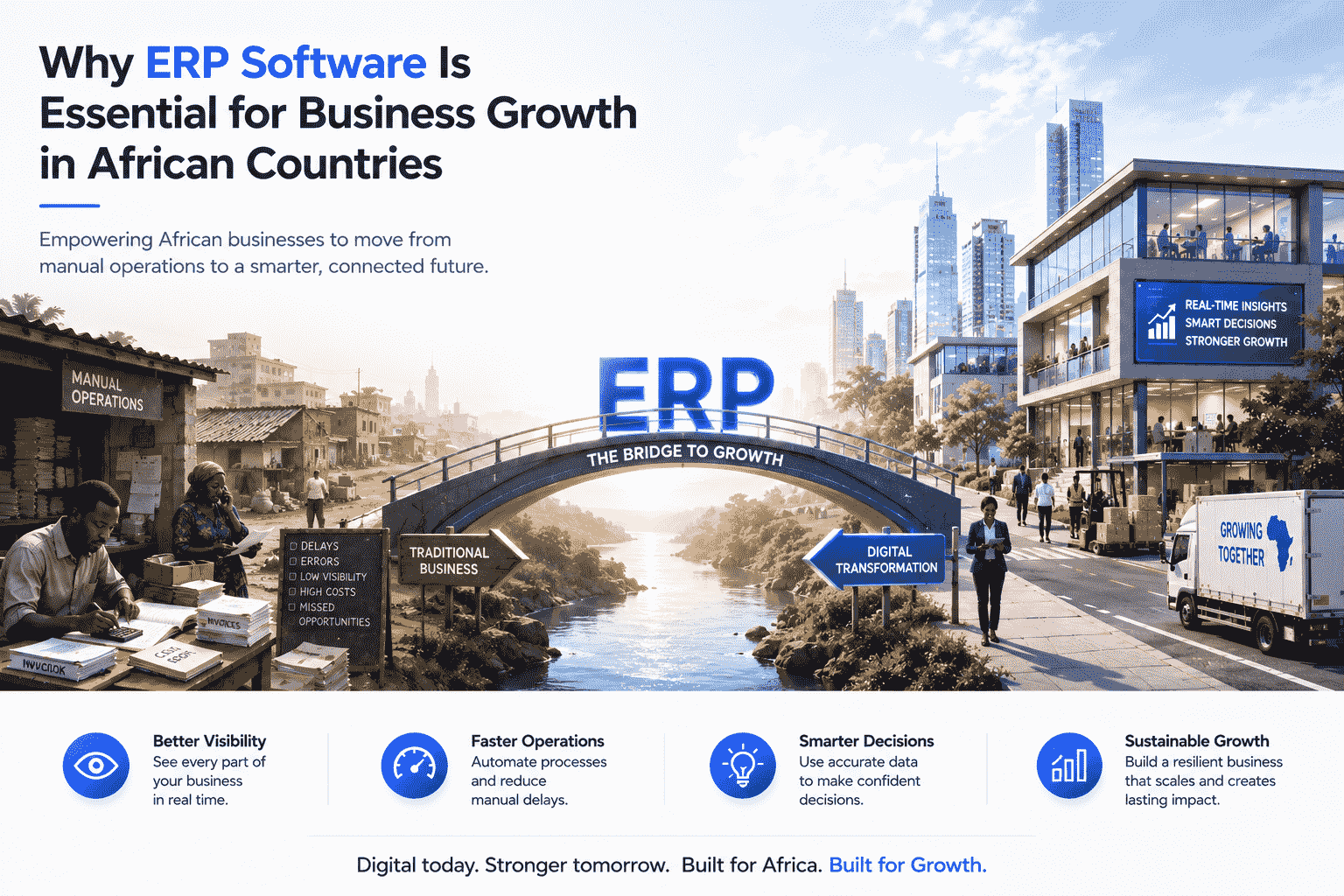
Why ERP software is essential for business growth in African countries
The rise of digital transformation in Africa
In today’s fast growing digital economy, businesses across are rapidly adopting technology to stay competitive.
From small businesses to large enterprises, organizations are rethinking how they manage operations, finances, and growth.
One of the most powerful tools driving this transformation is ERP software.
Impact:
Businesses that adopt digital systems early gain efficiency, visibility, and competitive advantage.
What is ERP software?
ERP software is a centralized business management system that helps organizations manage daily operations from a single platform.
It typically includes modules for accounting, inventory management, human resources, sales and CRM, and supply chain operations.
Instead of relying on multiple disconnected tools, ERP systems integrate everything into one streamlined workflow.
Impact:
Centralized systems reduce complexity and improve operational speed.
Why ERP is important for businesses in Africa
Many businesses still depend on manual processes or outdated systems.
ERP software automates routine tasks, reduces human error, and enables faster, more accurate business operations.
Impact:
Automation improves productivity while lowering operational risk.
Better financial management
ERP accounting modules provide real-time visibility into income, expenses, cash flow, and financial performance.
Businesses benefit from accurate financial reports, improved tax compliance, and stronger budget control.
Impact:
Real-time financial insights support smarter, faster decision making.
Inventory and supply chain optimization
For businesses dealing with physical goods, inventory mismanagement leads to losses.
ERP systems help track stock levels, reduce wastage, improve order fulfillment, and strengthen supply chain coordination.
Impact:
Optimized inventory reduces costs and improves customer satisfaction.
Supporting business growth and scalability
As businesses grow, managing operations manually becomes increasingly difficult.
ERP systems scale alongside the business, supporting expansion without increasing operational complexity.
Impact:
Scalable systems enable sustainable growth without operational overload.
Local compliance and multi-currency support
Many modern ERP solutions support local tax structures, regional regulations, and multi-currency transactions.
This is especially important for businesses operating across multiple African countries.
Impact:
Built in compliance reduces regulatory risk and simplifies cross-border operations.
Industries in Africa benefiting from ERP
ERP systems are widely used across multiple sectors including manufacturing, retail, healthcare, logistics, and agriculture.
Regardless of industry, ERP provides structure, visibility, and control.
Impact:
Industry-wide adoption proves ERP’s versatility and value.
Cloud ERP: a game changer for Africa
Cloud-based ERP solutions are gaining popularity due to lower upfront costs, mobile accessibility, and remote availability.
These benefits make cloud ERP ideal for startups and SMEs.
Impact:
Cloud ERP removes infrastructure barriers to digital adoption.
Challenges businesses face without ERP
Businesses that operate without ERP often struggle with data duplication, lack of real-time insights, poor coordination, and inefficient decision-making.
Impact:
Lack of system integration increases operational risk and slows growth.
How to choose the right ERP software
When selecting an ERP solution, businesses should consider ease of use, customization, pricing, industry fit, and customer support.
Choosing the right ERP partner is just as important as choosing the technology.
Impact:
The right ERP choice ensures long term value and smoother adoption.
The future of ERP in African markets
As digital transformation accelerates, ERP adoption across African markets is expected to grow rapidly.
Increased investment in technology is making ERP more accessible than ever.
Impact:
Early ERP adoption positions businesses ahead of market evolution.
Conclusion
ERP software is no longer a luxury it is a necessity for businesses aiming for efficiency, control, and long-term growth.
Whether a startup, SME, or enterprise, ERP enables African businesses to compete, scale, and succeed in a digital-first economy.