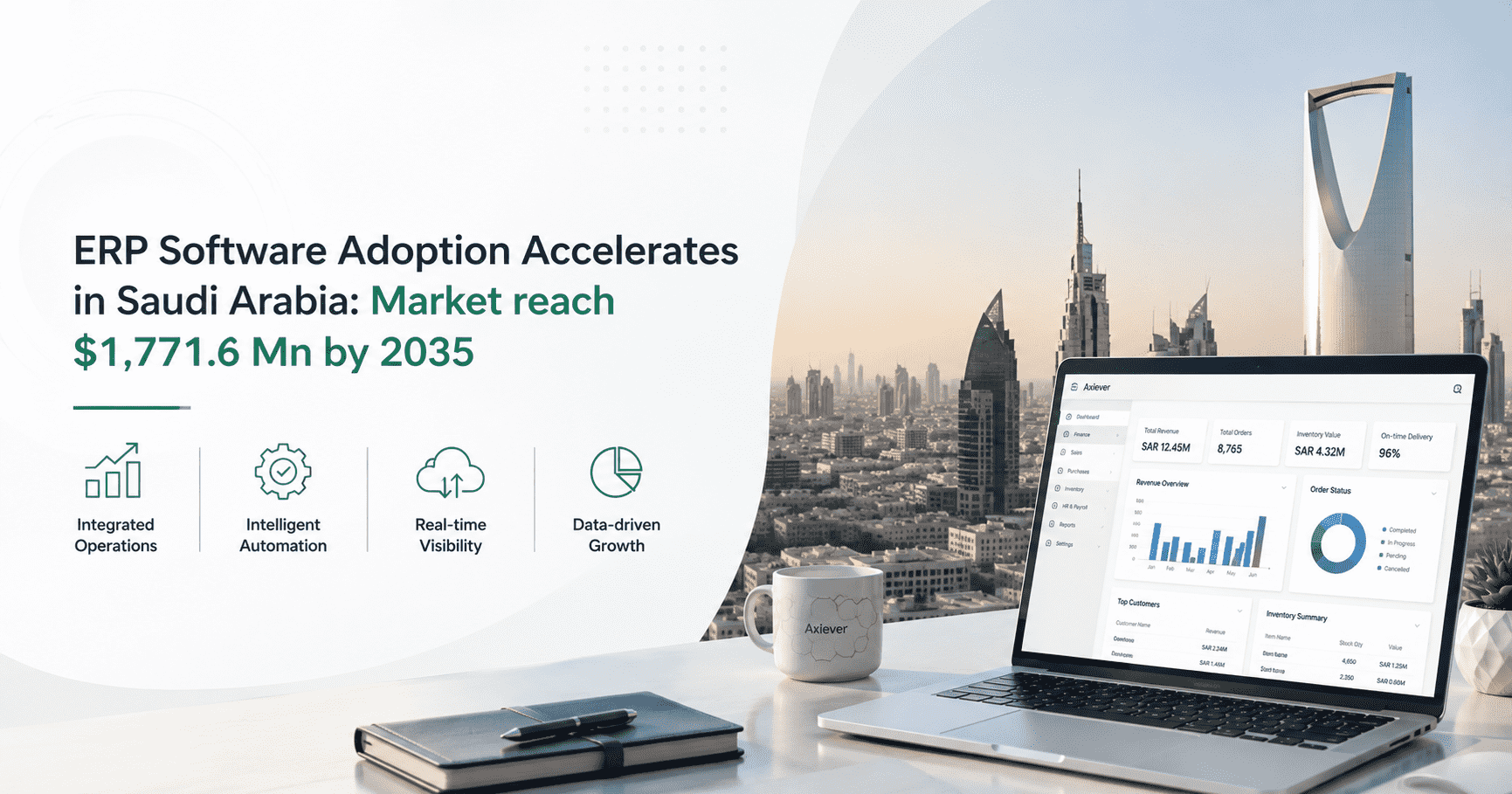
ERP software adoption in Saudi Arabia: Market reach $1,771.6 Mn by 2035
ERP software adoption in Saudi Arabia is accelerating as businesses increasingly invest in connected technology, automation, and data-driven operations. The market is projected to reach $1,771.6 million by 2035, highlighting the growing importance of integrated business management solutions.
According to recent reports, the Saudi Arabian ERP software market is expanding as organizations look for more efficient ways to manage business processes, improve visibility, and support digital transformation. This growth signals a fundamental change in how businesses view enterprise software. ERP is no longer limited to financial reporting or basic record keeping; modern solutions are increasingly being used to connect finance, inventory, procurement, sales, suppliers, customers, and operational workflows.
Why ERP adoption is growing in Saudi Arabia
The acceleration of ERP software adoption in Saudi Arabia is driven by the need for businesses to operate with greater speed, accuracy, and visibility. As organizations grow, managing information across spreadsheets, disconnected applications, and manual processes makes it harder for teams to maintain a consistent view of operations.
Businesses are increasingly looking for platforms that can help them:
- Access business information in real time
- Automate repetitive operational processes
- Connect data across departments
- Improve financial and operational visibility
- Reduce manual data entry
- Support faster business decisions
- Manage growing transaction volumes efficiently
These requirements are particularly critical for businesses operating across multiple locations, departments, suppliers, and customer accounts.
ERP is moving beyond traditional business management
The growth of the ERP market is heavily influenced by artificial intelligence and automation. Traditional systems primarily helped businesses record and organize information, but modern platforms are expected to help teams act on that data.
AI-powered capabilities support activities such as demand analysis, workflow automation, inventory monitoring, document processing, and operational decision-making. Instead of employees manually checking multiple records to understand inventory availability, an intelligent system brings relevant information together and helps teams identify what requires attention. This represents a broader shift from simply digitizing processes to creating intelligent business operations.
What this means for trading and distribution businesses
Trading and distribution companies can particularly benefit from connected business processes. Consider a typical transaction: a customer inquiry leads to a quotation, supplier communication, purchase activity, inventory allocation, delivery, documentation, and financial processing.
When every stage is handled separately, information becomes fragmented. A connected platform helps link these activities into a continuous workflow: Inquiry -> Quotation -> Supplier -> Order -> Inventory -> Delivery -> Documentation -> Finance. For companies navigating ERP software adoption in Saudi Arabia, this connected approach is valuable as operations grow more complex.
The role of AI and automation
The next phase of ERP development focuses heavily on intelligent automation. AI helps businesses work with historical data, operational signals, and business rules to support informed decisions, while automation reduces the repetitive work required to execute them. Together, these technologies improve inventory planning, supplier management, order processing, financial workflows, document management, and reporting. The objective is to let teams spend less time on routine tasks and more time on high-judgment decisions.
Axiever’s perspective
The growth of the Saudi ERP market reflects a wider shift toward connected and intelligent business management. At Axiever, the focus is on bringing critical processes together through a unified platform supported by AI and automation.
Axiever connects inventory, suppliers, orders, customers, documents, finance, and operations, helping businesses reduce manual work while gaining greater visibility. For trading and distribution companies, this creates a seamless journey from initial customer inquiry through to financial management. As ERP adoption in Saudi Arabia accelerates, the key question is how effectively technology can connect data and automate workflows.
Looking ahead
A projected market value of $1,771.6 million by 2035 points to the increasing role of ERP technology in Saudi Arabia’s evolving business landscape. For businesses preparing for the next stage of growth, choosing an ERP platform involves evaluating scalability, automation, integration, and real-time visibility. The future of business management is moving toward systems that actively drive execution rather than simply store information.