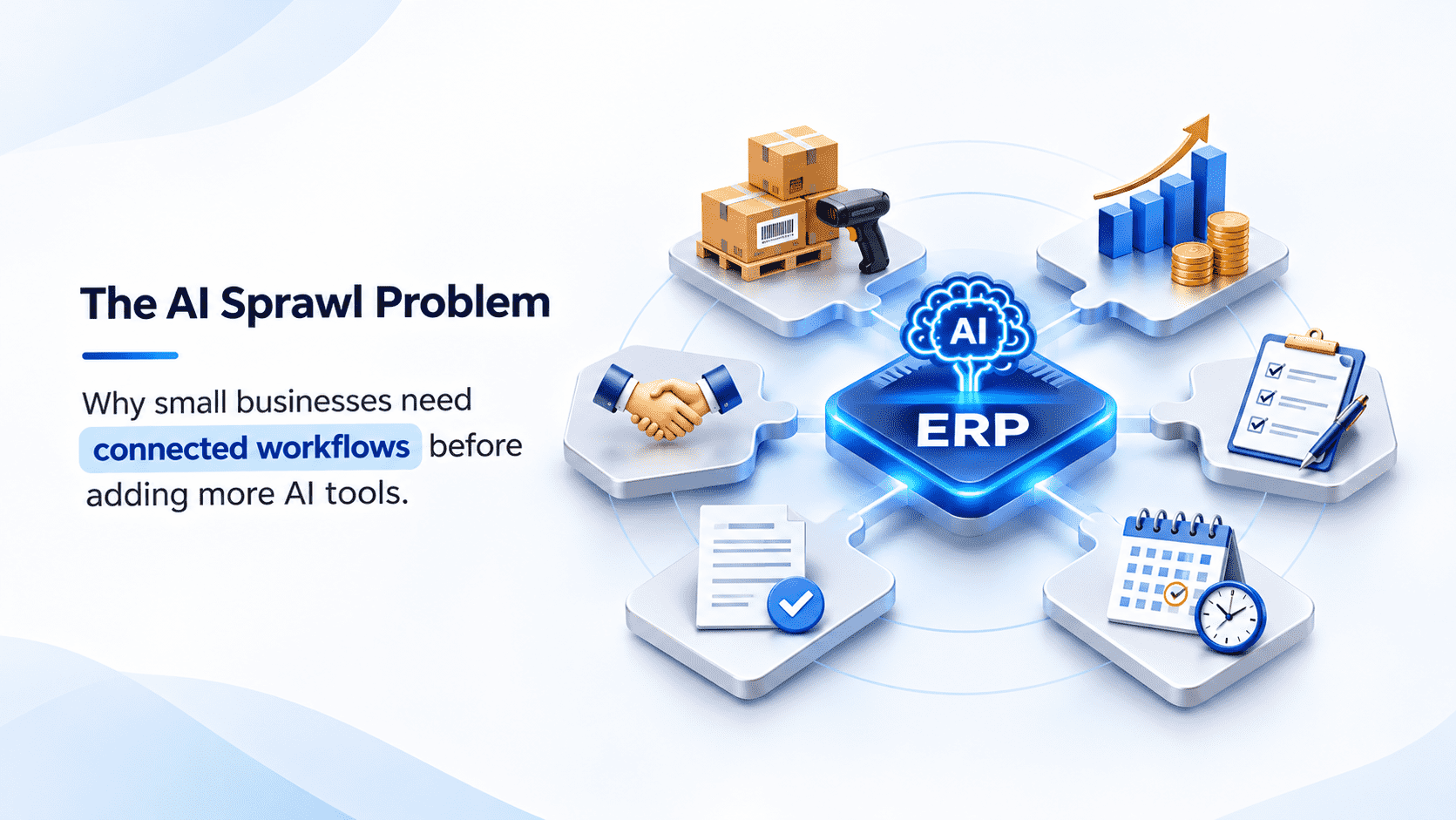
The AI sprawl problem: Why small businesses need connected workflows
Artificial intelligence is becoming part of everyday business operations. Companies are using AI to draft emails, analyse information, respond to customers, prepare reports and support business decisions. Each application promises to save time and improve productivity. However, adopting multiple tools without a clear strategy can create a new operational challenge: more technology, but not necessarily better results.
This challenge is known as AI sprawl — the uncontrolled spread of separate AI applications across departments, tasks and business systems. When these tools operate independently, employees often have to transfer information manually, repeat tasks and switch between platforms to complete routine processes.
For small and growing businesses, the priority should not simply be adding more technology. It should be creating a connected business environment where information moves efficiently and every tool has a defined purpose.
What does AI sprawl look like in a small business?
Consider a trading company using one AI application to draft customer emails, another to summarise enquiries, spreadsheets to manage quotations, separate software to track inventory and an accounting platform for invoices.
Each application may perform its individual task effectively. However, employees still need to transfer customer details, verify stock availability, update order records and share information with the finance team.
This is where AI sprawl becomes visible. Different applications support individual activities but do not work together as part of a complete business process.
The situation can become more complicated when employees independently adopt AI tools to solve immediate problems. Management may not know which applications are being used, what business information they access or whether their outputs are being reviewed.
Why is this becoming a business concern?
AI adoption is moving quickly. According to Pax8's October 2026 SMB AI Pulse research, 67% of AI-engaged small and medium-sized businesses surveyed had at least one internally built AI solution in regular use. The research also found that 35% had discovered AI tools, workflows or agents operating without official approval during the previous six months.
These findings highlight an important gap between adopting AI and managing it effectively. Businesses need visibility into their applications, clear usage policies and a better understanding of how automation fits into their existing operations.
Read the Pax8 SMB AI Pulse research for further insights.
Four problems created by disconnected AI tools
1. Business information becomes fragmented
When customer, supplier, inventory and financial information is stored across separate platforms, employees may work with different versions of the same data.
For example, a sales representative may prepare a quotation using an outdated price list while the operations team has already updated product information. This creates confusion, delays and unnecessary corrections.
2. Manual work continues behind automation
An AI tool may generate a quotation or summarise a customer enquiry, but the wider process may still depend on manual work.
Employees might need to copy the generated information into another system, verify the details and notify another department. The individual task becomes faster, but the overall workflow remains inefficient.
3. Data security and accountability become difficult
Every additional application introduces questions about data access, permissions and information handling.
Businesses need to know whether employees are uploading customer details, supplier agreements or financial documents to external platforms. They also need clear rules about who can use these tools and which outputs require human approval.
4. Technology costs become harder to control
Separate subscriptions can appear affordable when purchased individually. However, overlapping features, unused licences, integration expenses and employee training can increase the overall cost.
Businesses should evaluate the total operational value of each application rather than judging it only by its monthly subscription price.
Why connected workflows matter more than more tools
A connected workflow brings together the people, information and activities involved in completing a business process. Instead of treating every department as a separate operation, it creates a structured flow of information between relevant functions.
Imagine a distributor receiving a new customer enquiry. The sales team records the requirements, prepares a quotation and checks product availability. Once the customer approves the quotation, the information moves into sales order processing. Inventory, purchasing and finance teams can then work with consistent order details.
When these activities operate independently, employees repeatedly enter information and follow up with other departments. With connected workflows, information can move between relevant business functions with fewer manual hand-offs.
AI can support specific activities, such as summarising enquiries or identifying missing information. However, business rules, verification and employee approval should remain part of the process wherever necessary.
For trading and distribution companies, this coordination is particularly valuable because customer requirements, stock availability, supplier coordination and invoicing are closely connected.
Five practical ways to reduce AI sprawl
1. Identify every application being used
Start by creating a list of AI applications and automation tools used across departments. Record their purpose, users, subscription costs and the type of information they access.
Include applications adopted independently by employees. This gives management a clearer picture of the current technology environment.
2. Map existing business processes
Before investing in another tool, identify how important activities are currently completed.
Map processes such as enquiry-to-order, purchase-to-payment and order-to-invoice. Identify where employees repeat data entry, wait for approvals or transfer information between systems.
This helps businesses identify the actual operational problem instead of purchasing technology based on assumptions.
3. Establish responsible AI usage rules
Define which applications are approved, what information employees can share and which activities require human review.
A simple approval process for new applications can prevent uncontrolled adoption while still allowing teams to explore useful technology.
4. Prioritise integration
Evaluate whether existing business applications can share information or whether a central business management system can reduce the need for separate tools.
Prioritise consistent records for customers, products, suppliers, orders and financial transactions. Integration should reduce duplicate work and make information easier to access.
5. Measure business outcomes
Track measurable improvements such as quotation preparation time, order-processing errors, approval delays, duplicate data entry and software utilisation.
These indicators help management understand whether a tool is genuinely improving operations. Applications that provide little value should be reconsidered.
How an integrated business management system helps
An integrated business management system provides a shared operational foundation for different business functions. It connects activities such as customer management, inventory, supplier management, order processing, document management and finance.
For example, customer information can support sales activities, order records can connect demand with inventory, and supplier information can support purchasing decisions. Finance teams can also work with consistent transaction details.
This structure helps businesses reduce fragmented processes and identify where automation can provide practical value.
Axiever brings key business functions, including customer management, order management, inventory, supplier management, document management and finance, into a unified business management environment.
For growing organisations, this approach can help teams manage information more consistently, coordinate daily activities and build a stronger foundation for business automation.
Explore Axiever and its AI-powered ERP solutions to learn how connected business management can support smarter operations.
Build a connected foundation for smarter growth
AI can help businesses improve productivity, but technology delivers greater value when it supports well-organised processes. Adding applications without considering how they connect can increase complexity instead of simplifying daily operations.
Addressing AI sprawl requires businesses to understand their existing tools, establish responsible usage practices and prioritise connected information. The objective is not to eliminate every standalone application. It is to ensure that each tool has a clear purpose and contributes to measurable business outcomes.
Businesses that build connected workflows today can create a more organised foundation for future automation and sustainable growth.