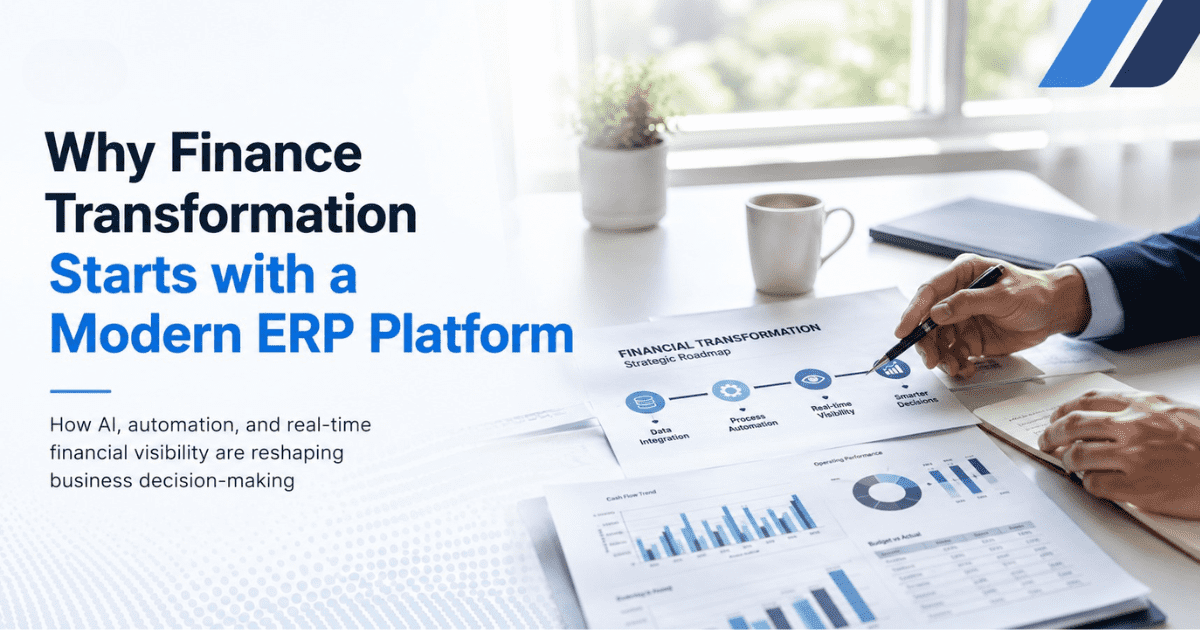
Why finance transformation starts with a modern ERP platform
Finance leaders today face a difficult balancing act. They must ensure compliance, manage risk, control costs, support business growth, and deliver insights that help organizations make smarter decisions.
At the same time, finance teams are expected to close books faster, improve forecasting accuracy, and respond quickly to changing market conditions. This growing pressure has made finance transformation a strategic priority across industries.
Key takeaway:
Finance transformation is not just about digitization—
it requires a connected ERP foundation that delivers
real-time visibility,
automation,
and intelligence.
The new expectations of modern finance teams
The role of finance has evolved significantly over the past decade. Traditionally, finance teams focused on transaction recording, account management, and reporting.
Today, leadership expects finance to act as a strategic partner— providing insights that drive growth, improve efficiency, and support better decision-making.
This shift has made finance transformation essential for organizations seeking agility and resilience in a fast-changing business environment.
Common challenges holding finance teams back
Despite growing expectations, many organizations still struggle with:
- Delayed access to financial data
- Manual reconciliations and spreadsheets
- Inconsistent reporting across departments
- Limited forecasting accuracy
- Compliance and audit complexity
- Lack of end-to-end performance visibility
These challenges consume time and resources, preventing finance teams from focusing on strategic initiatives.
Why legacy systems limit finance transformation
Many businesses still rely on legacy finance systems designed for a very different operating environment.
While these systems handle basic accounting, they often create silos between finance, procurement, inventory, sales, and operations.
As a result, finance teams spend significant time gathering data from multiple sources instead of analyzing and acting on insights.
A modern ERP platform eliminates these silos by creating a unified, real-time view of business performance.
The role of ERP in finance transformation
A modern ERP platform serves as the digital backbone of the organization.
By integrating financial management with procurement, inventory, sales, supply chain, and operations, ERP systems create a single source of truth.
This integration enables finance teams to move beyond transactional work and contribute directly to strategic planning and growth.
Real-time financial visibility
Modern ERP systems provide instant access to critical financial information, including:
- Revenue and profitability performance
- Cash flow and working capital
- Budget utilization
- Operating expenses
- Financial and operational KPIs
This real-time visibility allows leaders to make informed decisions based on current conditions, not outdated reports.
Faster financial closing
Financial closing remains one of the most resource-intensive processes for finance teams.
Modern ERP platforms automate key activities such as:
- Journal processing
- Account reconciliations
- Financial consolidation
- Approval workflows
- Compliance reporting
Automation reduces errors, shortens closing cycles, and improves reporting confidence.
Smarter forecasting and planning
Forward-looking insights are essential in a rapidly changing market.
Modern ERP platforms support finance transformation by enabling:
- Predictive cash flow forecasting
- Scenario planning
- Improved budget accuracy
- Risk identification
- Profitability analysis
How AI accelerates finance transformation
Artificial intelligence is reshaping how finance teams operate.
AI-powered ERP capabilities support:
- Intelligent invoice processing
- Automated anomaly detection
- Predictive forecasting
- Expense optimization
- Financial risk monitoring
By reducing manual effort and improving insight quality, AI enables finance teams to focus on strategy and innovation.
From transaction processing to strategic leadership
One of the most important outcomes of finance transformation is the evolution of finance into a strategic leadership function.
With integrated ERP systems, finance leaders can:
- Analyze profitability across business units
- Support investment decisions
- Improve operational efficiency
- Monitor enterprise risk
- Drive sustainable growth initiatives
How Axiever supports finance transformation
At :contentReference[oaicite:0]{index=0}, we believe finance transformation requires more than software implementation.
Axiever ERP helps organizations:
- Gain real-time financial visibility
- Automate core finance processes
- Improve budgeting and forecasting accuracy
- Strengthen governance and compliance
- Integrate finance with operations across the business
By combining intelligent automation, centralized data, and connected business processes, Axiever enables finance teams to deliver measurable business value.
Conclusion
Finance transformation is no longer optional. It is a critical business initiative for organizations that want to compete, grow, and adapt in a dynamic market.
A modern ERP platform provides the foundation for real-time visibility, automation, AI-driven insights, and scalable growth.
Organizations that invest in finance transformation today will be better positioned to improve efficiency, strengthen control, and unlock new opportunities in the future.