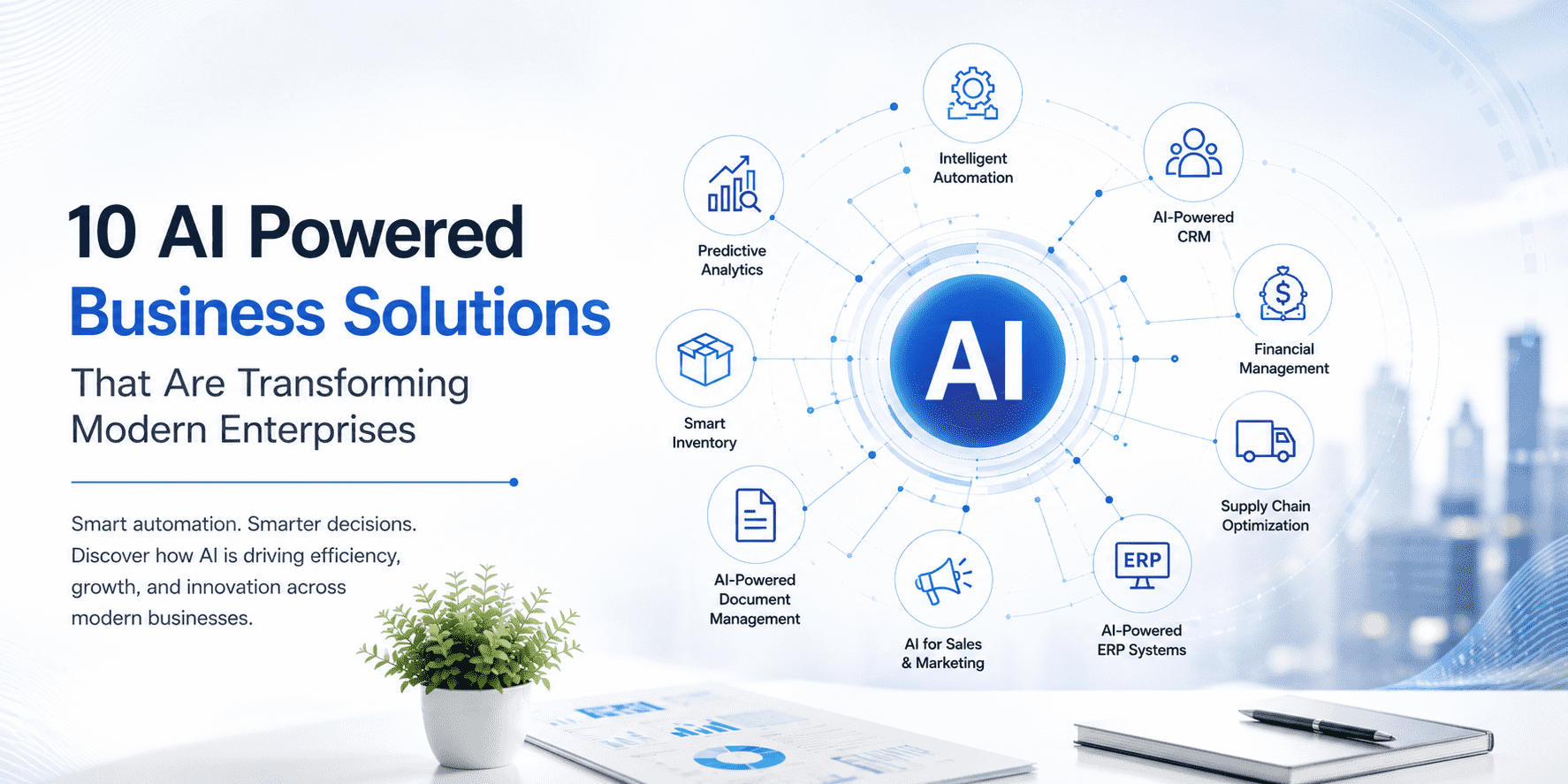
AI automation solutions for businesses: A complete guide to smarter business operations
In today's competitive business environment, organizations are under constant pressure to improve productivity, reduce operational costs, and deliver exceptional customer experiences. However, many businesses still rely on manual processes, disconnected systems, and repetitive tasks that slow down growth and increase the risk of errors. This is where AI Automation Solutions are transforming the way businesses operate.
By combining artificial intelligence with business process automation, companies can streamline workflows, improve decision-making, and free employees from repetitive work. Whether it's managing finance, procurement, inventory, customer relationships, or operations, AI-powered automation helps businesses become more agile and efficient.
What are AI automation solutions?
AI automation solutions use technologies such as Artificial Intelligence (AI), Machine Learning (ML), Robotic Process Automation (RPA), and workflow automation to automate routine business processes while making intelligent decisions based on data.
Unlike traditional automation, which follows predefined rules, AI-powered automation can analyze information, identify patterns, and continuously improve processes. This enables businesses to automate not only repetitive tasks but also workflows that require intelligent recommendations and predictive insights.
For growing businesses, adopting AI automation solutions means spending less time on manual operations and more time focusing on innovation, strategy, and customer satisfaction.
Why businesses are investing in AI automation
As businesses expand, operational complexity also increases. Employees often spend hours entering data, preparing reports, managing approvals, or coordinating between different software applications. These manual activities reduce productivity and create bottlenecks across departments.
Implementing AI automation solutions helps businesses overcome these challenges by creating connected and intelligent workflows. Automation reduces manual effort, minimizes human errors, and provides real-time visibility into business performance.
Organizations that embrace AI automation can respond faster to market changes, improve collaboration, and make better decisions using accurate, real-time data.
Key benefits of AI automation
Organizations leveraging intelligent automation experience transformative advantages across their entire operational footprint:
- Increased operational efficiency: Automate repetitive tasks such as invoice processing, purchase approvals, report generation, and document management to let teams focus on high-value work.
- Improved decision-making: AI analyzes large volumes of business data to identify trends, monitor performance, and provide real-time insights for faster and more confident decisions.
- Reduced operational costs: Minimize administrative work, cut down costly errors, and improve productivity without scaling up the workforce size.
- Better accuracy and compliance: Eliminate duplicate records and data inconsistencies while maintaining compliance with internal policies and regulatory requirements.
- Enhanced customer experience: Process customer requests faster, automate follow-ups, and improve communication throughout the customer journey for higher satisfaction.
Business functions that benefit from AI automation
Almost every department can improve its efficiency through automation:
- Finance: Automate invoice processing, budgeting, expense approvals, payment tracking, and financial reporting to enhance accuracy and financial visibility.
- Sales and customer relationship management: Benefit from automated lead management, quotation generation, follow-up reminders, customer segmentation, and sales forecasting.
- Procurement: Streamline purchase requests, supplier approvals, vendor management, and RFQ processing to reduce procurement delays and improve supplier collaboration.
- Inventory management: Monitor stock levels in real time, generate reorder alerts, forecast demand, and optimize warehouse operations to minimize stock shortages and excess inventory.
- Human resources: Automate employee onboarding, attendance management, leave approvals, payroll processing, and performance tracking.
AI automation vs Traditional automation
Traditional automation is designed to perform predefined tasks based on fixed rules. While it is effective for repetitive processes, it cannot adapt to changing business conditions or analyze complex information.
In contrast, AI automation solutions combine automation with intelligence. They learn from historical data, identify patterns, predict outcomes, and recommend actions that improve operational efficiency. This makes AI-powered automation far more valuable for businesses looking to optimize end-to-end operations rather than simply automate individual tasks.
Best practices for successful AI automation
Successfully implementing AI automation begins with understanding existing business processes.
Start by identifying repetitive and time-consuming workflows that create the greatest operational burden. Standardize these processes before introducing automation to ensure consistency across departments.
Businesses should also integrate their ERP, CRM, finance, inventory, and procurement systems to create a unified flow of information. Connected systems eliminate data silos and enable seamless automation across the organization.
Finally, monitor key performance indicators such as processing time, operational costs, employee productivity, and customer response times to measure success and find further improvement opportunities.
How Axiever helps businesses automate smarter
Axiever provides an AI-powered ERP platform designed to simplify and automate critical business operations. By integrating finance, procurement, inventory, customer relationship management, and workflow automation into a single platform, Axiever helps organizations eliminate manual processes and improve operational efficiency.
With Axiever, businesses can:
- Automate approvals and routine workflows
- Manage inventory in real time
- Streamline procurement processes
- Gain better financial visibility
- Generate meaningful business insights from centralized data
Instead of relying on disconnected applications, businesses gain one intelligent platform that supports sustainable growth and digital transformation.
Conclusion
Modern businesses cannot rely on manual processes if they want to remain competitive. AI Automation Solutions enable organizations to streamline operations, improve productivity, reduce costs, and make faster, data-driven decisions.
As AI continues to reshape the future of business, investing in intelligent automation is no longer optional—it's a strategic advantage. By combining automation with an integrated ERP platform like Axiever, businesses can build smarter workflows, improve operational visibility, and create a scalable foundation for long-term success.
Organizations that adopt AI automation solutions today will be better prepared to adapt, innovate, and grow in an increasingly digital business landscape.