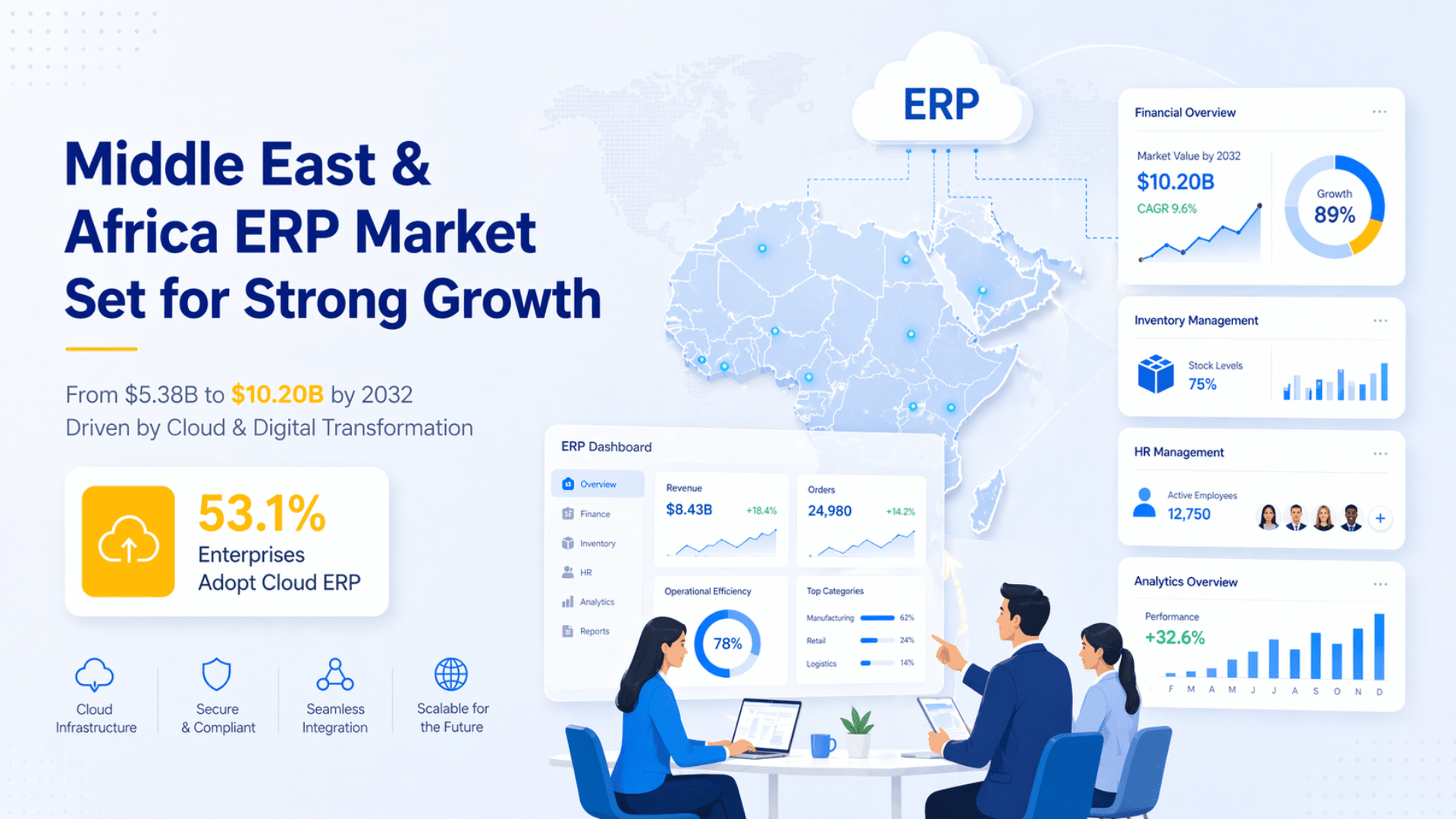
Middle East & Africa ERP market set for strong growth through 2032
Market overview
The middle East & Africa enterprise resource planning (ERP) software market is witnessing steady expansion, driven by accelerating digital transformation and growing cloud adoption across industries.
According to a report by fortune business insights, the market was valued at USD 5.38 billion in 2024 and is expected to grow from USD 5.68 billion in 2025 to USD 10.20 billion by 2032, registering a CAGR of 8.7% during the forecast period.
What is driving ERP adoption?
ERP software plays a critical role in modern organizations by integrating core business functions such as finance, operations, inventory, and human resources into a unified system.
This integration enables organizations to:
- Streamline business processes
- Improve operational efficiency
- Gain real-time visibility across departments
- Reduce manual errors and data duplication
- Enable faster, data-driven decision-making
Shift toward cloud based ERP
The report highlights a significant shift toward cloud-based ERP solutions across the region.
- 53.1% of enterprises have already implemented cloud-based ERP systems
- Remaining organizations continue to rely on on-premise deployments, particularly in traditional sectors
The preference for cloud ERP is driven by:
- Scalability and operational flexibility
- Lower infrastructure and maintenance costs
- Remote and multi-location accessibility
Key growth drivers
Several macro and industry-level factors are accelerating ERP adoption in the Middle East & Africa region:
- Government led digital transformation initiatives
- Rapid expansion of SaaS (Software as a Service) platforms
- Rising demand from product-centric industries
- Growing need for centralized business management systems
Impact of COVID-19 on ERP adoption
The COVID-19 pandemic had a mixed but ultimately positive impact on ERP adoption.
While supply chain disruptions created operational challenges, the shift toward remote work and digital operations significantly increased demand for ERP platforms.
- Maintaining operational continuity
- Managing distributed teams
- Digitizing core workflows
Industry development example
In july 2021, microsoft corporation introduced advanced integrations between dynamics 365 and microsoft teams, enabling seamless collaboration on customer data.
The company also launched industry specific cloud solutions tailored for:
- Healthcare
- Financial services
- Manufacturing
- Retail
These developments reflect a broader industry shift toward cloud-native, collaborative ERP ecosystems.
Market outlook
With sustained investment in digital infrastructure, supportive government policies, and rising cloud adoption, the Middle East & Africa ERP market is expected to maintain strong growth momentum through 2032.
ERP platforms are increasingly becoming the backbone of digital operations across industries in the region.