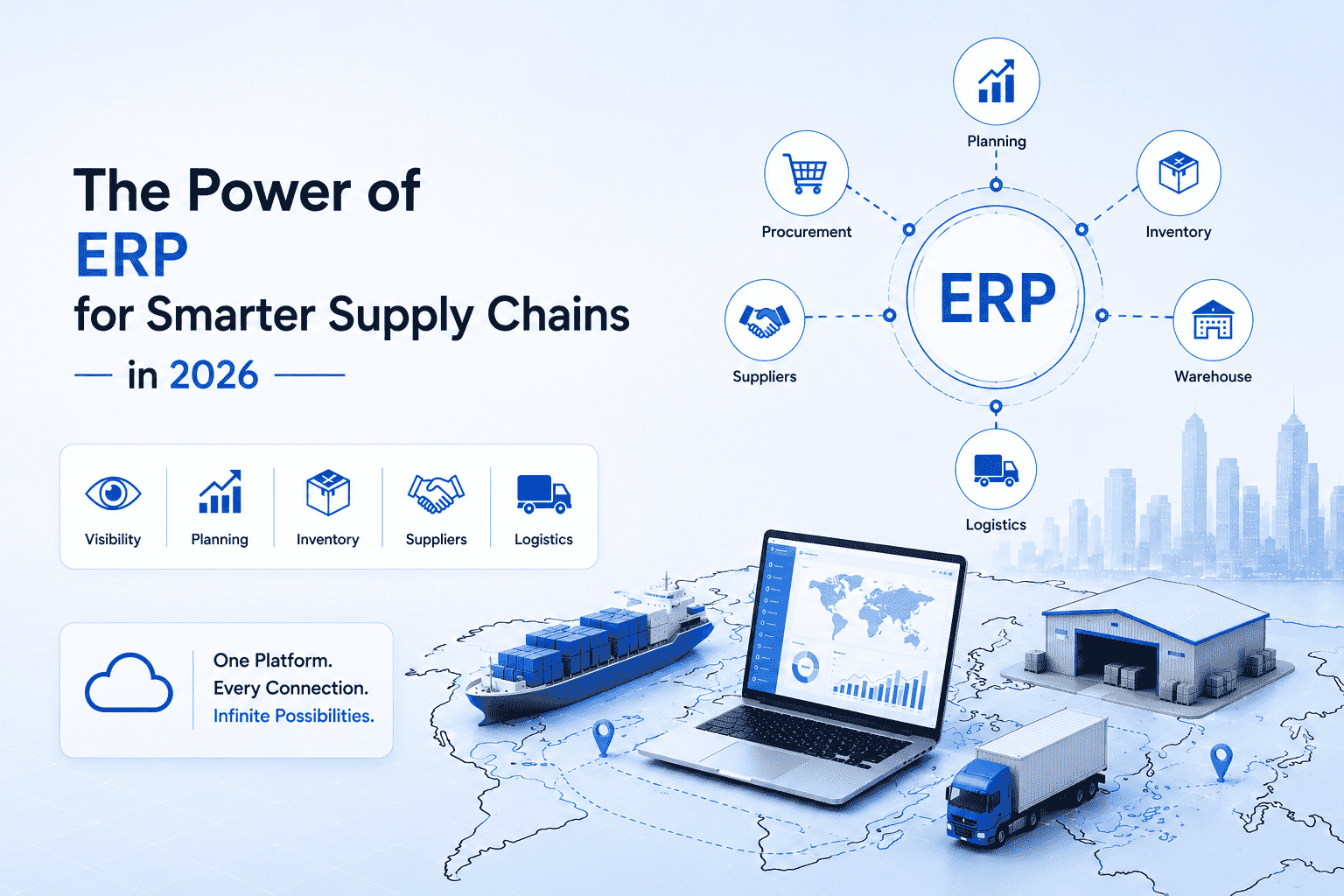
The power of ERP in managing supply chains in 2026
Why supply chain management needs ERP in 2026
Today’s supply chains are more complex than ever. Businesses face fluctuating demand, rising operational costs, supplier disruptions, and increasing customer expectations. To remain competitive, organizations need greater visibility, automation and control across their supply chain operations.
This is where ERP Supply Chain Management becomes essential. By integrating procurement, inventory, warehousing, production, logistics and finance into one platform, ERP systems enable real-time decision-making and streamlined operations.
Key takeaway:
ERP transforms supply chains from reactive operations
into intelligent,
data-driven ecosystems.
The 2026 supply chain landscape
Supply chains are evolving rapidly, driven by digital transformation, AI adoption, sustainability initiatives, and increased focus on risk management. ERP systems play a central role in helping businesses adapt to these changes.
AI-driven operations
Modern ERP supply chain management solutions use artificial intelligence to improve demand forecasting, optimize inventory, and identify potential disruptions before they impact operations.
Sustainability focus
Businesses are increasingly tracking carbon emissions, supplier compliance, and ESG metrics. ERP systems simplify sustainability reporting and provide greater operational transparency.
Supplier diversification
Organizations are reducing reliance on single source suppliers and building more resilient supplier networks through improved procurement visibility and supplier performance tracking.
Resilience over cost cutting
In 2026, agility and business continuity are taking priority over short-term cost reductions. ERP systems help businesses manage risks and respond quickly to supply chain disruptions.
Key benefits of ERP supply chain management
Real time visibility
Access accurate, up-to-date data across procurement, inventory, production, and logistics from a centralized platform.
Process automation
Automate purchasing, inventory updates, order processing, and reporting to reduce manual effort and minimize errors.
Better forecasting
Use historical and real-time data to predict demand, optimize inventory levels, and improve production planning.
Stronger supplier management
Track supplier performance, manage contracts, and improve collaboration across the supply chain.
Essential ERP supply chain management capabilities
1. Inventory management
- Real-time stock tracking
- Automated replenishment
- Multi-location inventory control
- Inventory optimization
2. Procurement management
- Purchase requisitions and orders
- Supplier performance monitoring
- Contract management
- Spend analysis
3. Demand planning
- Forecasting tools
- Production planning
- Inventory optimization
- Demand analysis
4. Warehouse management
- Barcode scanning
- Inventory movement tracking
- Picking and packing optimization
- Warehouse performance monitoring
5. Logistics management
- Shipment tracking
- Route optimization
- Freight management
- Delivery scheduling
6. Production planning
- Work order management
- Resource allocation
- Capacity planning
- Material requirements planning
7. Analytics and reporting
- Inventory turnover analysis
- Supplier performance reports
- Forecast accuracy tracking
- Supply chain KPI monitoring
Choosing the right ERP solution
When selecting an ERP system, businesses should evaluate:
- Industry-specific functionality
- Scalability and flexibility
- Integration capabilities
- User experience
- Total cost of ownership
A well-chosen ERP Supply Chain Management solution should support current operations while enabling long-term growth.
The role of AI in ERP supply chain management
AI enhances ERP supply chain capabilities through:
- Predictive demand forecasting
- Intelligent inventory optimization
- Automated decision-making
- Early risk detection
These capabilities help businesses improve efficiency and make faster, data-driven decisions.
Why choose Axiever ERP
:contentReference[oaicite:0]{index=0} helps organizations gain complete control over their supply chain through:
- End-to-end operational visibility
- Smart inventory management
- Automated procurement workflows
- Real-time analytics and dashboards
- Scalable business growth support
With ERP Supply Chain Management powered by Axiever, businesses can streamline operations, improve forecasting, reduce costs, and build resilient supply chains.
Conclusion
As supply chains become increasingly complex, businesses need technology that delivers visibility, efficiency, and agility. ERP Supply Chain Management provides the tools required to optimize inventory, automate processes, strengthen supplier relationships, and improve decision-making.
By implementing Axiever ERP, organizations can transform supply chain operations, enhance customer satisfaction, and create a strong foundation for sustainable growth in 2026 and beyond.