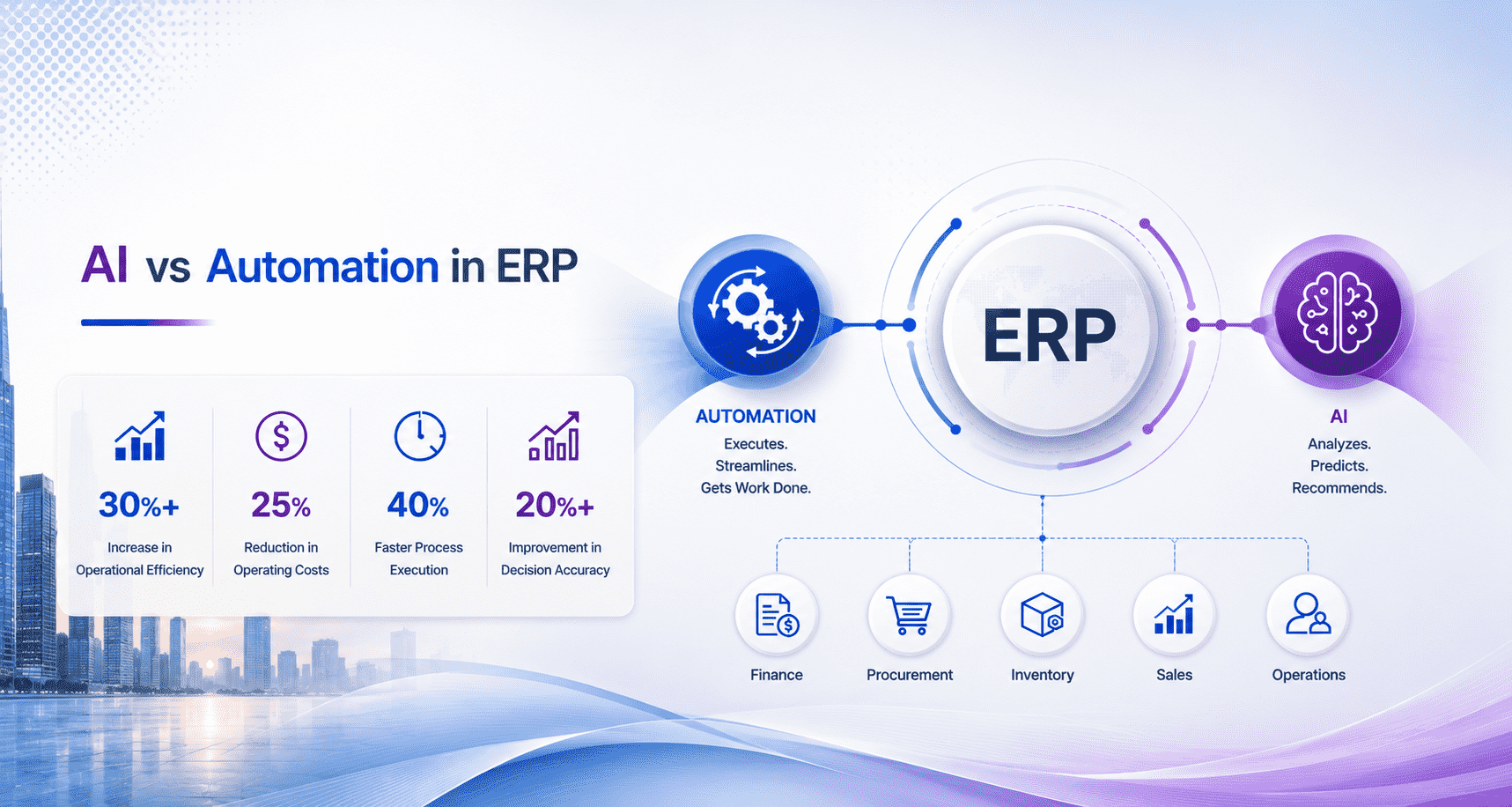
AI vs Automation in ERP: Why understanding the difference matters for modern businesses
Introduction
Artificial intelligence is transforming the way businesses operate, and ERP software is no exception. Today, many ERP vendors promote AI-powered capabilities, but one question continues to create confusion: What is the difference between AI and automation?
Understanding AI vs Automation in ERP is essential for businesses planning digital transformation. While both technologies improve efficiency, they serve different purposes. Automation focuses on executing repetitive tasks based on predefined rules, whereas AI analyzes business data to provide insights, predictions, and recommendations.
Knowing where each technology fits helps organizations choose the right ERP solution, maximize ROI, and build a stronger foundation for long-term growth.
What Is AI vs Automation in ERP?
When discussing AI vs Automation in ERP, it's important to understand that these technologies complement rather than replace each other.
ERP automation follows predefined business rules. Once a workflow is configured, the system automatically performs repetitive tasks without human intervention.
Automation can:
- Generate purchase orders when inventory reaches a reorder level
- Route invoices for approval
- Send payment reminders automatically
- Update stock after every sales transaction
- Trigger notifications for overdue activities
Automation increases speed, consistency, and operational efficiency, but it cannot learn from changing business conditions.
Artificial Intelligence goes beyond fixed rules. AI analyzes historical and real-time business data, identifies patterns, predicts future outcomes, and provides recommendations that support better business decisions.
Automation follows predefined rules. AI learns from business data and helps organizations make smarter decisions.
Why AI vs Automation in ERP matters
Many organizations expect AI to solve every operational challenge immediately after implementation. In reality, AI delivers meaningful results only when supported by structured business processes and accurate data.
Understanding AI vs Automation in ERP helps businesses:
- Set realistic technology expectations
- Invest in the right ERP capabilities
- Improve existing business processes
- Build a reliable data foundation
- Achieve better returns from ERP investments
Rather than viewing AI as a replacement for automation, organizations should see them as complementary technologies that work together.
Real business examples
Procurement
Automation: When inventory falls below the minimum stock level, the ERP automatically creates a purchase order and routes it for approval.
AI: The ERP analyzes supplier performance, delivery times, seasonal demand, and pricing trends before recommending the best supplier and optimal purchase timing.
Finance
Automation: Handles recurring invoices, payment reminders, and approval workflows.
AI: Predicts cash flow, detects unusual financial transactions, forecasts revenue, and identifies customers likely to delay payments.
Inventory management
Automation: Updates stock levels and generates reorder requests.
AI: Forecasts future demand, recommends ideal inventory levels, identifies slow-moving products, and helps reduce excess inventory costs.
Common misconceptions about AI vs Automation in ERP
Automation is AI
Many automated ERP workflows are rule-based and do not involve artificial intelligence. Automation improves efficiency, but it does not learn from data.
AI makes every decision
AI provides recommendations and predictive insights, but business users remain responsible for making critical decisions and approvals.
AI works without good data
Successful AI depends on high-quality business data. Without accurate information, AI cannot generate reliable recommendations.
Building the right foundation
Before implementing AI capabilities, businesses should first establish a strong ERP foundation by focusing on:
- Standardized business processes
- Centralized business data
- Automated routine workflows
- Department-wide integration
- Reliable reporting
- Strong data governance
Once these fundamentals are in place, AI can generate insights that improve planning, forecasting, procurement, finance, and operational performance.
How Axiever combines AI and automation
At Axiever, we understand that successful digital transformation requires both operational efficiency and intelligent decision-making.
Our cloud-based ERP solution combines workflow automation with real-time business intelligence to streamline finance, procurement, inventory, sales, and operations. By integrating automation with intelligent capabilities, businesses can eliminate repetitive manual work while gaining actionable insights that support faster and more informed decisions.
Instead of treating AI as a standalone feature, Axiever focuses on delivering practical intelligence that works within connected business processes, helping organizations improve productivity, enhance visibility, and scale with confidence.
Final thoughts
Understanding AI vs Automation in ERP is no longer optional for businesses investing in modern enterprise technology. Automation improves operational efficiency by handling repetitive tasks, while AI delivers predictive insights that support smarter business decisions.
The most effective ERP solutions combine both capabilities. Automation ensures consistency and speed, while AI enables organizations to forecast trends, optimize operations, and respond proactively to changing business needs.
Businesses that recognize the true value of AI vs Automation in ERP will be better positioned to improve efficiency, make data-driven decisions, and achieve sustainable growth. With a modern ERP platform like Axiever, organizations can build a future-ready business that leverages both automation and intelligent decision-making to stay competitive in an evolving digital landscape.