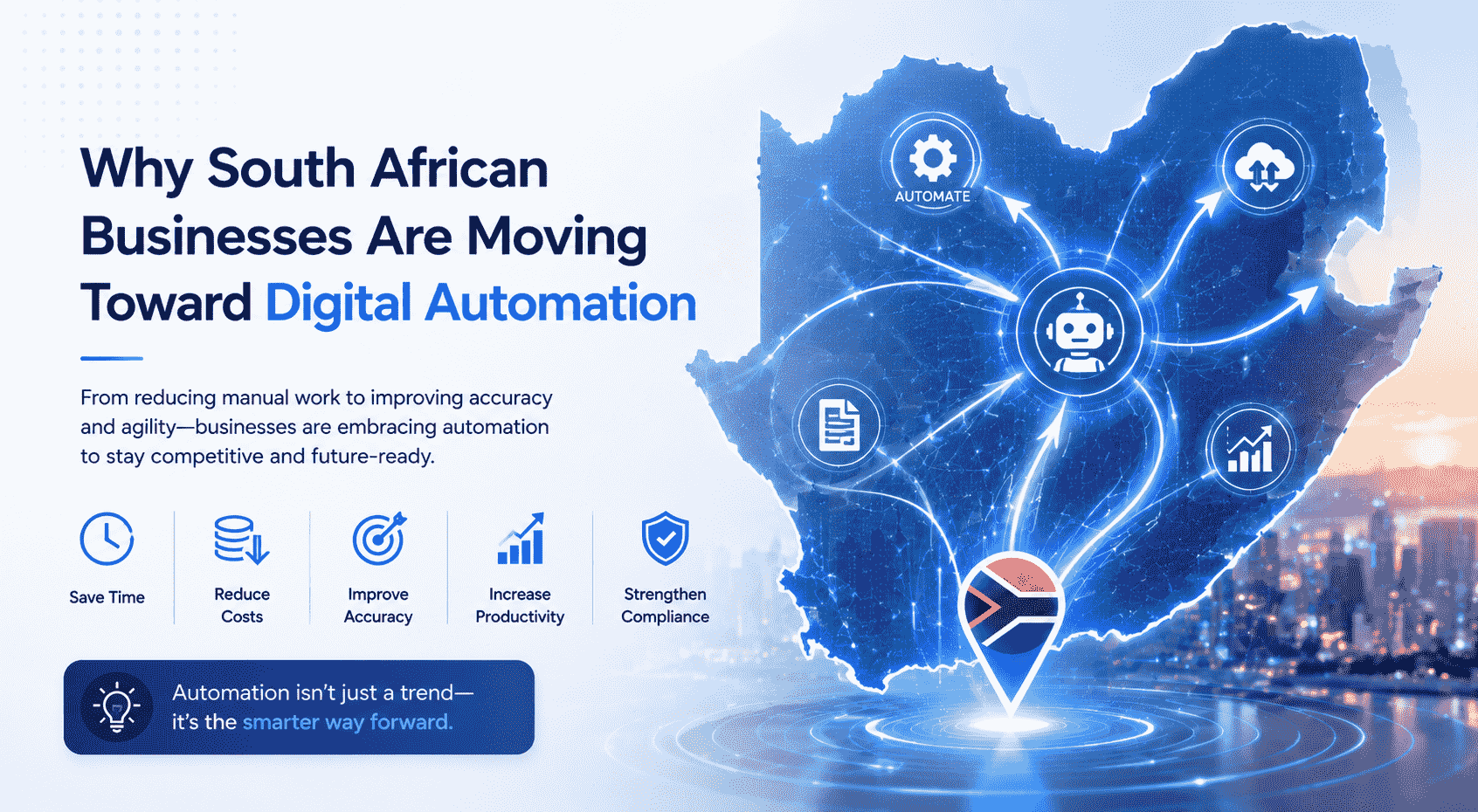
Why South African businesses are moving toward digital automation
Digital automation becomes a business necessity
South African businesses are increasingly embracing digital automation as they navigate a rapidly evolving business landscape shaped by rising operational costs, growing customer expectations and the need for greater efficiency. What was once considered a competitive advantage has now become a business necessity.
Organizations of all sizes are investing in automation technologies to streamline operations, improve productivity and support long-term growth in an increasingly digital economy.
Key takeaway:
Digital Automation enables businesses
to operate faster,
smarter
and more efficiently.
Increased efficiency and productivity
One of the primary reasons businesses are adopting Digital Automation is its ability to improve operational efficiency. Manual processes often consume valuable time, create bottlenecks and increase the likelihood of errors.
Automation streamlines repetitive tasks, accelerates workflows, and improves consistency across departments. From customer service and finance to procurement and inventory management, employees can focus on strategic initiatives rather than routine administrative work.
Reducing operational costs
Cost optimization remains a major priority for South African organizations. Digital Automation helps businesses achieve more with existing resources by minimizing manual intervention and reducing inefficiencies.
Automated workflows lower administrative costs, improve resource utilization, and reduce costly errors related to billing, reporting, inventory management, and customer communications. Over time, these improvements contribute to stronger profitability.
Enhancing customer experiences
Modern customers expect fast, accurate, and personalized interactions. Businesses that fail to meet these expectations risk losing market share to more agile competitors.
Digital Automation enables quicker responses through automated communication systems, customer portals, intelligent chatbots, and workflow-driven service processes. Automated customer management systems also improve interaction tracking and service quality at scale.
Supporting data-driven decision making
Data has become one of the most valuable business assets, but manual data collection and analysis is time-consuming and inefficient.
Digital Automation solutions capture, process and analyze data in real time. Automated reporting provides visibility into sales performance, operational efficiency, customer behavior, and financial metrics, enabling faster and better decisions.
Enabling scalability and business growth
As organizations grow, manual processes often become obstacles. Higher transaction volumes, larger customer bases, and more complex operations strain traditional workflows.
Digital Automation allows businesses to scale efficiently without proportionally increasing costs. Automated systems handle higher workloads, integrate with new technologies, and support expansion while maintaining consistency.
Gaining a competitive advantage
Businesses that adopt automation early position themselves ahead of competitors. Faster operations, improved accuracy, enhanced customer service, and better decision-making create measurable market advantages.
Across South Africa, organizations are moving beyond experimentation and focusing on automation initiatives that deliver real business outcomes.
The growing role of AI and intelligent automation
The next phase of transformation is being driven by artificial intelligence and intelligent automation. South African organizations are increasingly exploring AI-powered solutions to optimize workflows, improve forecasting, and generate insights.
This shift moves businesses beyond simple task automation toward intelligent process optimization, accelerating Digital Automation adoption throughout 2026 and beyond.
What this means for ERP-driven businesses
For organizations investing in ERP platforms, Digital Automation maximizes technology value. By integrating automation with ERP systems, businesses connect finance, procurement, inventory, sales, customer service, and supply chain operations.
This unified digital ecosystem improves visibility, strengthens collaboration, and enables faster, data-driven decision-making.
Axiever insight:
Digital Automation is no longer just an IT initiative.
It is a strategic business capability
that drives efficiency,
customer experience,
and long-term competitive advantage.