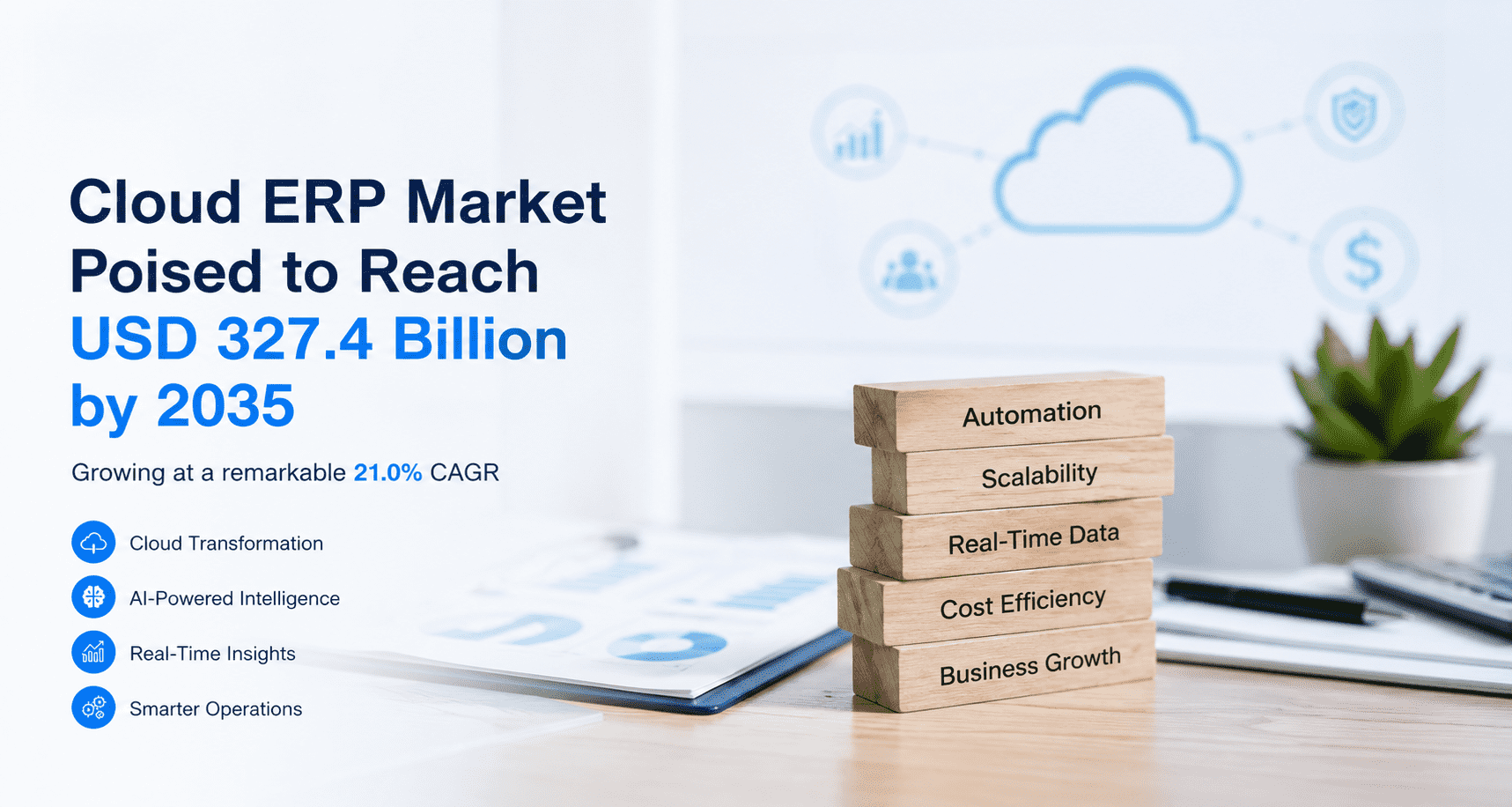
Axiever pulse: cloud ERP market poised to reach USD 327.4 Billion by 2035
The cloud ERP market is entering a new era of growth. According to a recent industry report, the global Cloud ERP Market is projected to reach USD 327.4 billion by 2035, expanding at a remarkable 21.0% CAGR. This surge reflects the increasing demand for cloud-based business management platforms that help organizations improve efficiency, automate operations, and make faster decisions.
As businesses continue their digital transformation journey, cloud ERP solutions are becoming the preferred choice for companies seeking agility, scalability, and intelligent automation.
Why the cloud ERP market is growing
The rapid expansion of the cloud ERP market is driven by organizations looking to replace disconnected legacy systems with unified, cloud-powered platforms. Businesses today require real-time access to data, seamless collaboration across departments, and the flexibility to scale without investing heavily in on-premise infrastructure.
Several factors are accelerating market growth, including:
- Rising adoption of AI-powered business applications
- Increasing demand for remote and hybrid workforce support
- Need for real-time operational visibility
- Lower infrastructure and maintenance costs
- Faster ERP deployment through cloud technology
- Growing investment in digital transformation initiatives
These trends demonstrate that cloud ERP has evolved from a business convenience into a strategic necessity.
AI is reshaping business operations
Artificial intelligence is becoming one of the biggest catalysts behind the Cloud ERP Market. Modern ERP platforms now offer intelligent forecasting, predictive analytics, automated workflows, and real-time insights that enable businesses to make proactive decisions.
Instead of spending valuable time on repetitive manual processes, organizations can automate finance, procurement, inventory management, customer relationship management, and supply chain operations. This allows teams to focus on business growth while improving operational accuracy.
As AI capabilities continue to mature, cloud ERP solutions will become even more intelligent, helping businesses respond faster to market changes and customer demands.
Why businesses should pay attention
The continued growth of the cloud ERP market highlights a major shift in how businesses approach enterprise technology. Companies are no longer investing in ERP solely for record-keeping—they expect intelligent platforms that connect every department and provide a complete view of business performance.
Organizations that adopt cloud ERP solutions benefit from:
- Faster business processes
- Improved productivity
- Better financial visibility
- Enhanced collaboration
- Real-time reporting
- Easier scalability as the business grows
These advantages help businesses remain competitive in increasingly dynamic markets.
The Axiever perspective
At Axiever, we view the growth of the cloud ERP market as a clear indicator that businesses need smarter and more connected enterprise solutions. Modern organizations require ERP systems that not only manage operations but also drive business transformation through automation and intelligence.
Axiever delivers a cloud-based business management platform designed to simplify complex operations while enabling sustainable growth. With AI-powered automation, integrated finance, inventory, procurement, CRM, document management, and real-time analytics, businesses gain complete visibility across their operations from a single platform.
Whether supporting trading companies, distributors, manufacturers, or growing enterprises, Axiever helps organizations streamline workflows, improve decision-making, and scale confidently in a rapidly evolving business environment.
Looking Ahead
The projected expansion of the cloud ERP market confirms that cloud-first business management is becoming the global standard. Organizations investing in intelligent ERP today will be better prepared to adapt to future market demands, leverage AI innovations, and achieve long-term operational excellence.
As the cloud ERP landscape continues to evolve, businesses that embrace automation, scalability, and data-driven decision-making will be best positioned for sustainable success.
The Cloud ERP Market is growing rapidly. The real opportunity lies in choosing an ERP platform that helps your business grow with it.