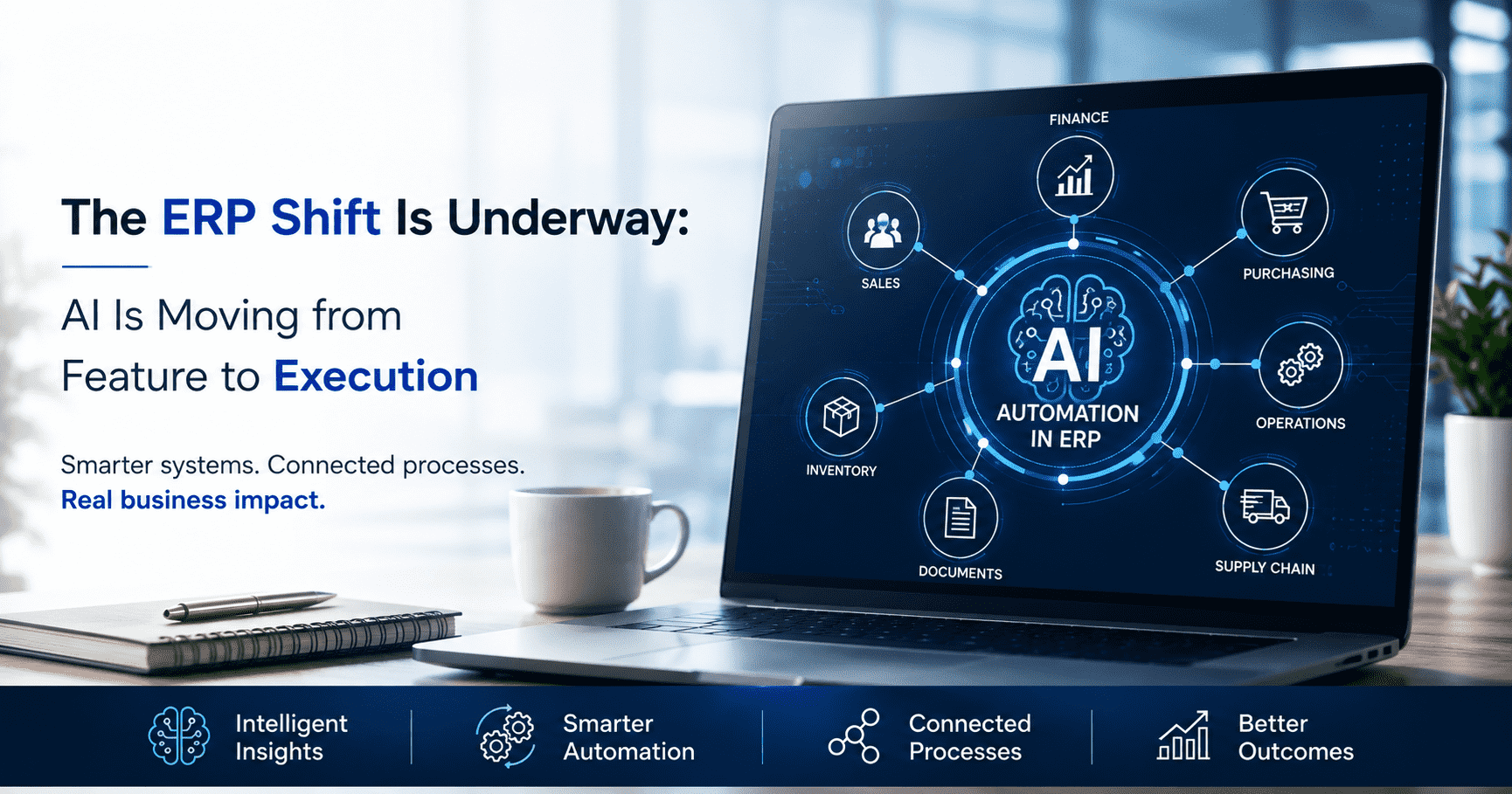
The ERP shift is underway: AI is moving from feature to execution
For years, artificial intelligence in business software was largely presented as an additional capability: a smarter report, a forecasting tool, or an assistant layered onto an existing system. That picture is changing. AI is increasingly moving deeper into business systems, where it can support not only analysis but also the execution of everyday processes. For ERP, this represents an important shift as businesses begin to expect their systems to do more than store information and show what has already happened.
The emerging expectation is that ERP should help businesses understand what is happening, identify what requires attention, and support what needs to happen next. This is where AI automation in ERP is becoming particularly significant.
From AI features to AI-Driven workflows
Traditional ERP systems brought departments such as finance, purchasing, inventory, sales, and operations onto a common platform. That integration gave businesses greater visibility, but many processes still depended on people manually moving information from one stage to another. AI and automation are beginning to change that model.
Instead of employees constantly checking reports, identifying exceptions, updating records, and passing information between departments, intelligent systems can increasingly assist with these repetitive operational steps. In a trading and distribution business, connected processes can become far more responsive, ensuring information generated at one stage informs the next while exceptions are routed to the right person.
Why integration matters more than ever
AI alone does not solve fragmented operations. Its usefulness depends heavily on the quality and availability of business data. If customer information sits in one application, inventory in another, and financial records somewhere else, there is limited context for intelligent automation. A connected ERP environment provides a common operational foundation, allowing businesses to use intelligence within actual workflows rather than treating it as a separate tool.
The shift from insight to action
Business software has traditionally been good at answering "What happened?" Modern analytics expanded that capability by helping organizations understand why. AI is now pushing business systems toward answering "What should happen next?" By identifying unusual inventory movement, highlighting purchasing requirements, or detecting exceptions, intelligent systems bring insights closer to the workflow where decisions take place.
Automation does not remove the human role
The move toward intelligent execution does not mean every business decision should be automated. Many decisions still require experience, judgment, negotiation, and accountability. Technology reduces the operational effort surrounding those decisions, enabling teams to spend less time searching for information and more time focusing on work where people create the greatest value.
What this means for ERP strategy
When evaluating ERP platforms today, businesses must look beyond basic module checklists and ask how effectively those functions communicate:
- Can information move across the business without constant manual intervention?
- Can the system recognize exceptions?
- Can automation respond to routine events?
- Can AI provide useful context at the point of decision-making?
The Axiever perspective
At Axiever, we see this shift as part of a broader evolution in how businesses manage operations. Connecting inventory, orders, customers, suppliers, documents, and finance creates the foundation, while AI and automation make those connections more useful by reducing repetitive work. The objective should not be AI for the sake of AI, but an environment where technology helps people operate with better visibility and fewer manual steps.
Conclusion
As AI automation in ERP continues to evolve, the distinction between systems that simply record business activity and systems that actively support execution will become increasingly important. ERP once helped businesses bring their information together; the next shift is about helping businesses put that information to work.