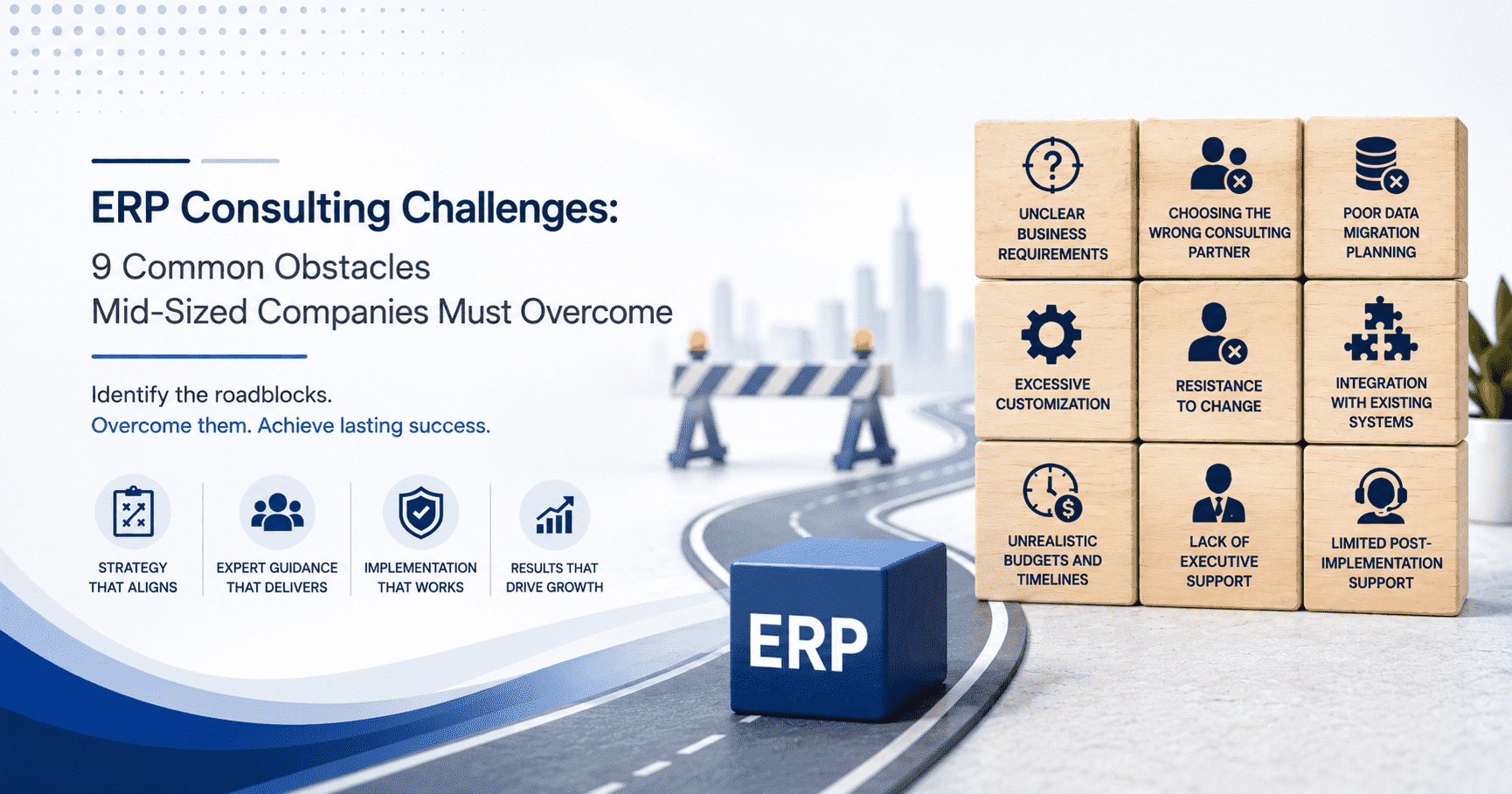
ERP consulting challenges: 9 Common obstacles mid-sized companies must overcome
Digital transformation has become a necessity for growing businesses, and enterprise resource planning (ERP) systems are at the center of that transformation. However, many organizations underestimate the ERP consulting challenges involved in implementing an ERP solution. Choosing the right software is only one part of the journey—the expertise of your ERP consulting partner often determines whether the project succeeds or fails.
From unclear business goals to poor user adoption, ERP consulting challenges can impact project timelines, budgets, and overall business performance. Understanding these challenges before starting an ERP implementation helps organizations reduce risks and maximize their return on investment.
Why understanding ERP consulting challenges matters
Every business has unique processes, workflows, and operational requirements. A successful ERP implementation requires more than installing software—it requires strategic planning, process optimization, and expert guidance.
Ignoring ERP consulting challenges often leads to implementation delays, increased costs, low employee adoption, and systems that fail to meet business objectives. By addressing these issues early, businesses can ensure a smoother transition and long-term success.
1. Unclear Business Requirements
One of the most common ERP Consulting Challenges is beginning the project without clearly defining business requirements.
Many companies focus on software features instead of identifying operational problems that need solving. Without a clear understanding of existing workflows, consultants may configure the ERP system in ways that don't align with business needs.
Solution: Conduct detailed business process mapping before selecting or implementing an ERP solution.
2. Choosing the wrong ERP consulting partner
Not every consultant has the experience required for your industry or business size.
An inexperienced partner may overlook critical business processes, recommend unnecessary customizations, or fail to create a realistic implementation roadmap.
Solution: Choose an ERP consulting partner with proven expertise, industry knowledge, and a structured implementation methodology.
3. Poor data migration planning
Migrating years of customer, supplier, inventory, and financial data is often more complicated than expected.
Incomplete or inaccurate data can create reporting errors, operational disruptions, and user frustration after implementation. Poor migration planning remains one of the biggest ERP Consulting Challenges for mid-sized businesses.
Solution: Clean, validate, and standardize data before migrating it into the new ERP platform.
4. Excessive customization
Businesses often request extensive software customization to replicate outdated processes.
While customization may seem beneficial, it increases implementation costs, complicates upgrades, and creates long-term maintenance challenges.
Instead of changing the software to fit inefficient processes, businesses should evaluate opportunities to improve workflows using standard ERP capabilities.
5. Resistance to change
Technology projects succeed only when employees adopt the new system.
One of the overlooked ERP consulting challenges is change management. Employees may hesitate to use new software if they don't understand its benefits or receive adequate training.
Solution: Involve employees early, provide hands-on training, and communicate how the ERP system improves their daily work.
6. Integration with existing systems
Most organizations rely on multiple applications, including CRM platforms, accounting software, payroll systems, eCommerce platforms, and business intelligence tools.
Failing to plan integrations early can increase costs and delay implementation.
A skilled ERP consulting team evaluates all existing systems and creates an integration strategy before implementation begins.
7. Unrealistic budgets and timelines
Many businesses only consider software licensing costs while overlooking consulting, data migration, testing, training, and post-implementation support.
These hidden expenses frequently lead to budget overruns and project delays, making financial planning one of the major ERP Consulting Challenges.
Solution: Develop a comprehensive project budget that includes every phase of the implementation lifecycle.
8. Lack of executive support
ERP implementation impacts every department, making leadership involvement essential.
Without executive sponsorship, project priorities become unclear, decision-making slows, and employee engagement decreases.
Business leaders should actively participate throughout the implementation to ensure organizational alignment and faster decision-making.
9. Limited post-implementation support
Many organizations assume the project ends once the ERP system goes live.
In reality, the first few months after deployment are critical for resolving issues, optimizing workflows, and helping employees adapt to the new system.
Continuous support ensures businesses realize the full value of their ERP investment and continue improving operational performance.
Best practices to overcome ERP consulting challenges
Businesses can significantly improve implementation success by following a structured approach:
- Clearly define project objectives and success metrics.
- Select an experienced ERP consulting partner.
- Prepare and validate business data before migration.
- Minimize unnecessary software customization.
- Invest in employee training and change management.
- Plan system integrations from the beginning.
- Create realistic budgets and implementation timelines.
- Ensure executive involvement throughout the project.
- Continue optimizing the ERP system after go-live.
Following these best practices helps organizations overcome ERP consulting challenges while reducing implementation risks and improving long-term business outcomes.
Why choose Axiever for ERP consulting?
At Axiever, we understand that every business has unique operational requirements. Our ERP consulting approach focuses on business process optimization before technology implementation, helping organizations overcome ERP consulting challenges with confidence.
Our team provides:
- Business process analysis
- ERP implementation planning
- AI-powered workflow automation
- Secure data migration
- System integration
- User training and onboarding
- Ongoing optimization and support
Whether you're replacing legacy software or implementing a cloud-based business management solution for the first time, Axiever helps you achieve a faster, smoother, and more successful ERP implementation.
Conclusion
Successfully implementing an ERP system requires more than selecting the right software. Businesses must understand and address ERP Consulting Challenges related to planning, data migration, customization, integration, change management, and post-implementation support.
By partnering with an experienced ERP consulting provider like Axiever, organizations can reduce implementation risks, improve operational efficiency, and achieve long-term business growth. Investing in the right consulting expertise today ensures your ERP project delivers measurable results for years to come.