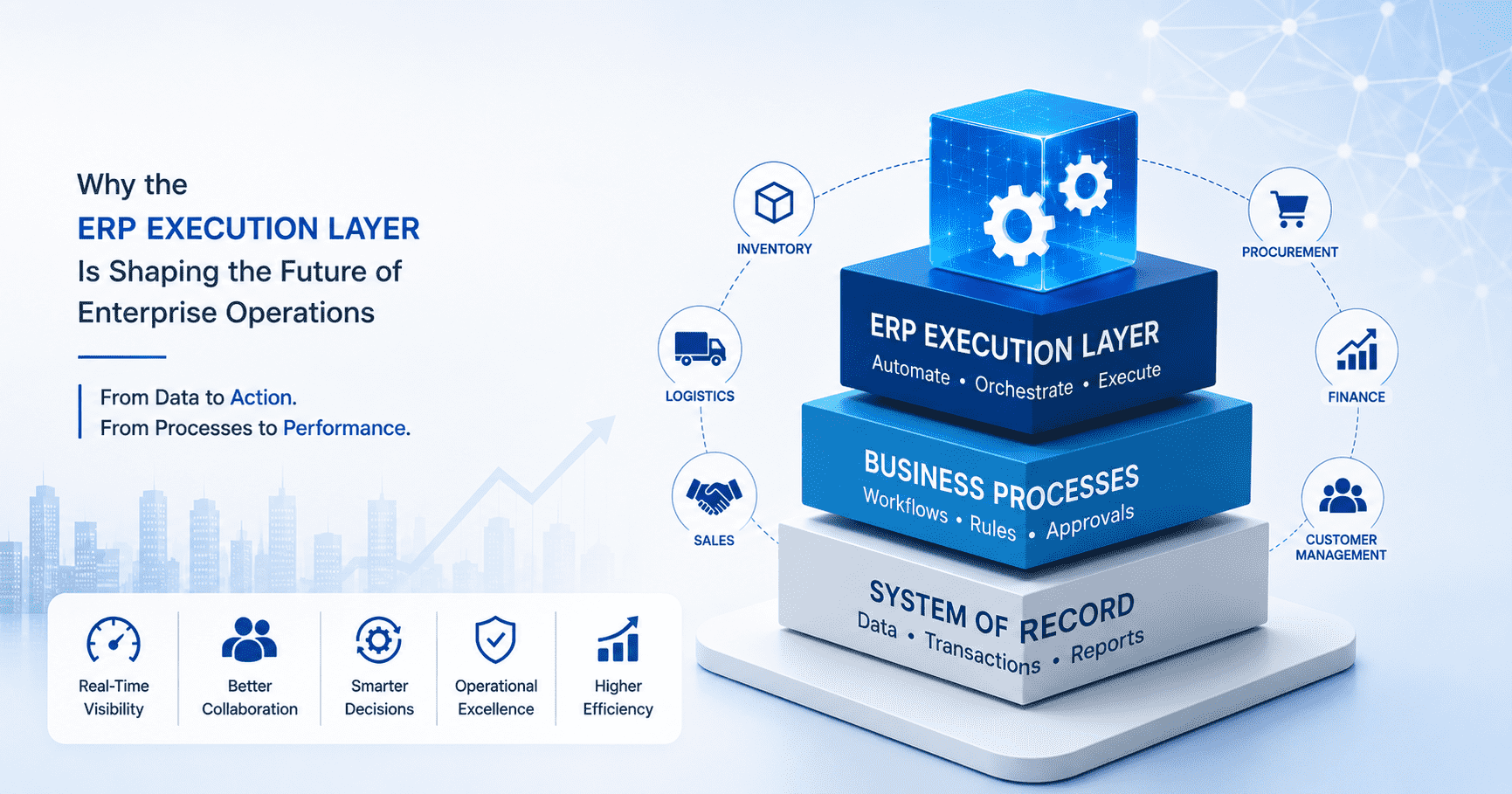
Why the ERP execution layer is shaping the future of enterprise operations
Introduction
Enterprise resource planning (ERP) has long been recognized as the backbone of business operations. Traditionally, ERP systems were designed to store financial records, inventory data, procurement details, and customer information. While these capabilities remain essential, today's organizations expect much more from their business software. The ERP execution layer has emerged as the next evolution of enterprise technology, enabling businesses to move beyond record-keeping and into real-time operational execution.
As organizations face increasing market complexity, the ability to automate workflows, connect departments, and make decisions based on live data has become a competitive advantage. This shift is redefining the role of ERP in modern enterprises.
From system of record to ERP execution layer
For decades, ERP systems primarily acted as systems of record. They documented completed transactions, generated reports, and provided historical insights into business performance. Although valuable, these systems often relied on employees to interpret data and manually trigger the next steps.
The ERP execution layer changes that approach entirely.
Instead of simply recording business events, modern ERP platforms actively coordinate business processes across finance, procurement, inventory, sales, logistics, and customer management. Information flows seamlessly between departments, allowing actions to be triggered automatically based on predefined business rules and real-time conditions.
This evolution transforms ERP into a platform that supports continuous business execution rather than passive data management.
The ERP execution layer transforms ERP from a system that records business activity into a platform that actively coordinates and executes business processes in real time.
Why businesses need an ERP execution layer
Today's businesses operate in an environment where delays can directly impact customer satisfaction and profitability. Manual approvals, disconnected software, and duplicate data entry often slow operations and create unnecessary complexity.
An ERP execution layer addresses these challenges by connecting every stage of the business process. When inventory falls below a defined threshold, procurement workflows can begin automatically. Customer orders can update inventory, notify warehouse teams, and provide finance with immediate visibility. Managers receive accurate information without waiting for multiple systems to synchronize.
This level of automation reduces operational bottlenecks while improving collaboration across departments.
Technologies driving the ERP execution layer
Several emerging technologies are accelerating the transition toward the ERP execution layer.
Artificial intelligence
Artificial intelligence helps businesses identify trends, forecast demand, and recommend actions based on operational data. Instead of relying solely on historical reports, organizations gain predictive insights that support proactive decision-making.
Workflow automation
Workflow automation eliminates repetitive manual tasks such as approvals, notifications, document routing, and purchase requests. Employees spend less time managing routine processes and more time focusing on strategic work.
Cloud technology
Cloud technology enables secure access to ERP systems from virtually anywhere while providing scalability for growing organizations.
Connected integrations
APIs connect ERP with CRM platforms, eCommerce systems, payroll software, logistics providers, and other business applications. These integrations ensure data moves efficiently throughout the organization, creating a connected operational environment.
Together, these technologies make the ERP execution layer a critical component of digital transformation.
Business benefits beyond automation
Automation is only one part of the story. The true value of an ERP execution layer lies in its ability to improve operational agility.
Organizations gain:
- Faster decision-making through real-time visibility
- Improved collaboration across departments
- Reduced manual intervention
- Higher process accuracy
- Better customer responsiveness
- Increased operational efficiency
Instead of working with fragmented information spread across multiple systems, employees access a single source of truth that supports coordinated business execution.
As businesses expand into new markets or manage more complex supply chains, these capabilities become increasingly important for sustainable growth.
What this means for business leaders
Business leaders are no longer evaluating ERP systems based solely on reporting capabilities. They want platforms that actively support business operations, simplify decision-making, and improve execution across the enterprise.
The ERP execution layer enables organizations to respond faster to changing customer expectations, supply chain disruptions, and market opportunities. By integrating operational data with intelligent workflows, businesses can adapt quickly without increasing manual effort.
This evolution also helps reduce operational risk by ensuring standardized processes are followed consistently across every department.
The Axiever perspective
At Axiever, we believe ERP should do more than capture business data. Modern organizations need intelligent business management solutions that help teams execute faster, collaborate more effectively, and respond confidently to change.
Our approach focuses on connecting finance, procurement, inventory, sales, customer management, and operational workflows within a unified platform. By bringing these functions together, businesses gain greater visibility, stronger process control, and improved operational efficiency.
As enterprise technology continues to evolve, the ERP execution layer will play an increasingly important role in helping organizations transform data into action. Businesses that embrace this shift will be better positioned to improve productivity, accelerate growth, and build resilient operations for the future.