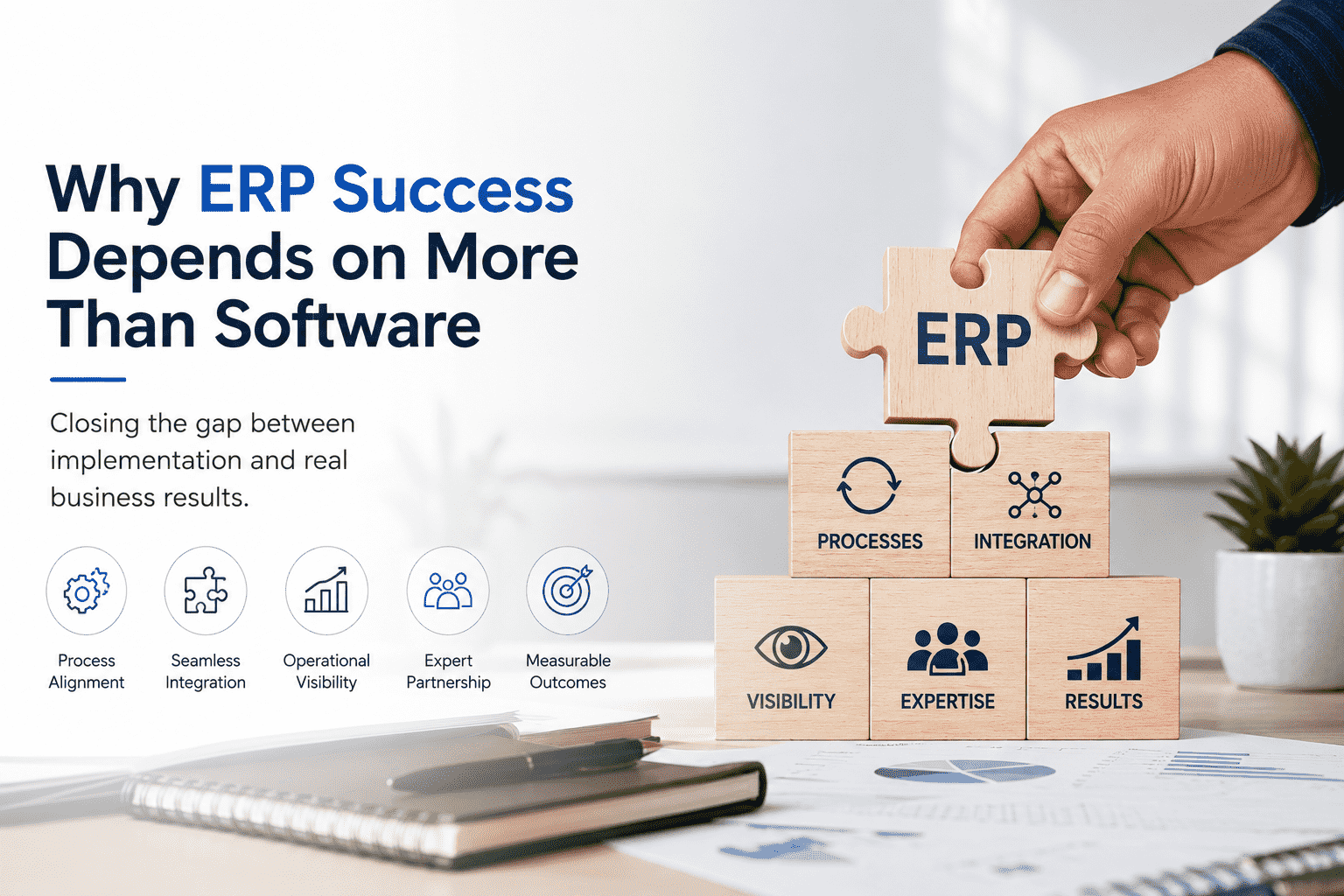
Why ERP success depends on more than software
Many ERP projects do not fail because of bad software.
They fail because businesses expect technology to fix operational problems that existed long before the ERP was installed.
Key takeaway:
ERP success depends on process design,
integration,
and operational alignment
—not software alone.
The hidden gap between ERP implementation and business results
A distributor struggling with inventory inaccuracies expects a new ERP system to solve the problem.
A trading company hopes for real-time financial visibility after go-live. A growing organization expects automation to eliminate operational bottlenecks.
Yet months after implementation, the same challenges often remain.
- Inventory counts still do not match physical stock
- Teams continue maintaining spreadsheets
- Approvals move through emails and messaging apps
- Management waits until month-end for profitability insights
The software works. The business does not.
This is why ERP success depends on much more than platform selection.
Software does not fix broken processes
One of the biggest misconceptions in ERP projects is believing that technology automatically improves operations.
If procurement approvals are unclear, supplier data is scattered, and decisions rely on individuals instead of workflows, installing ERP software does not remove inefficiencies.
Without redesigning processes, organizations simply move the same problems into a new system.
True ERP success occurs when businesses rethink how work flows before automation begins.
Successful ERP projects start with questions
- Why does this process exist?
- Where are decisions getting delayed?
- What information is missing?
- Which activities should be automated?
- What visibility does management actually need?
Only after these questions are answered does ERP technology begin delivering meaningful value.
The real value of an ERP ecosystem
An ERP platform provides software.
An ERP ecosystem provides business expertise.
This difference matters because every organization operates differently.
Trading, distribution, manufacturing, and services businesses face unique operational challenges that no standard ERP product can fully address on its own.
This is why implementation partners, consultants, integration specialists, and solution experts play a critical role in ERP success.
They bridge the gap between software capabilities and real-world business operations.
Why integrations often determine ERP success
Many organizations evaluate ERP systems based on features.
Few evaluate how well those systems connect with the rest of the business.
In reality, most operational delays occur between systems—not inside them.
- Sales updates data in CRM
- Finance manages invoicing separately
- Warehouse teams rely on spreadsheets
- Procurement tracks suppliers through email
- Management receives delayed reports
Each system works independently. The business does not.
ERP success increasingly depends on creating connected business ecosystems where information flows seamlessly.
The difference between go-live and ERP success
Go-live means the software is operational.
ERP success means business outcomes improve.
- Inventory accuracy increases
- Cash flow becomes predictable
- Procurement cycles shorten
- Financial reporting accelerates
- Customer response times improve
- Management gains real-time visibility
These results rarely happen automatically.
Organizations achieving the highest ERP ROI continuously refine processes, automate repetitive work, and use ERP data to improve decision-making.
How Axiever approaches ERP success differently
At :contentReference[oaicite:0]{index=0}, we treat ERP as a business strategy, not a software deployment.
Our focus is not just implementation. It is eliminating operational friction.
For trading and distribution businesses, this means creating seamless flows from inquiry to quotation, procurement, inventory allocation, delivery, and invoicing.
For finance teams, it means replacing reactive reporting with real-time business insights.
This approach enables sustainable ERP success because technology supports business objectives rather than operating in isolation.
ERP success is built through partnership
ERP success is not measured by how many modules are implemented.
It is measured by how effectively the business performs after implementation.
Achieving that outcome requires:
- Process optimization
- Integration expertise
- Operational understanding
- Continuous improvement
Because in the end, ERP success depends on much more than software.