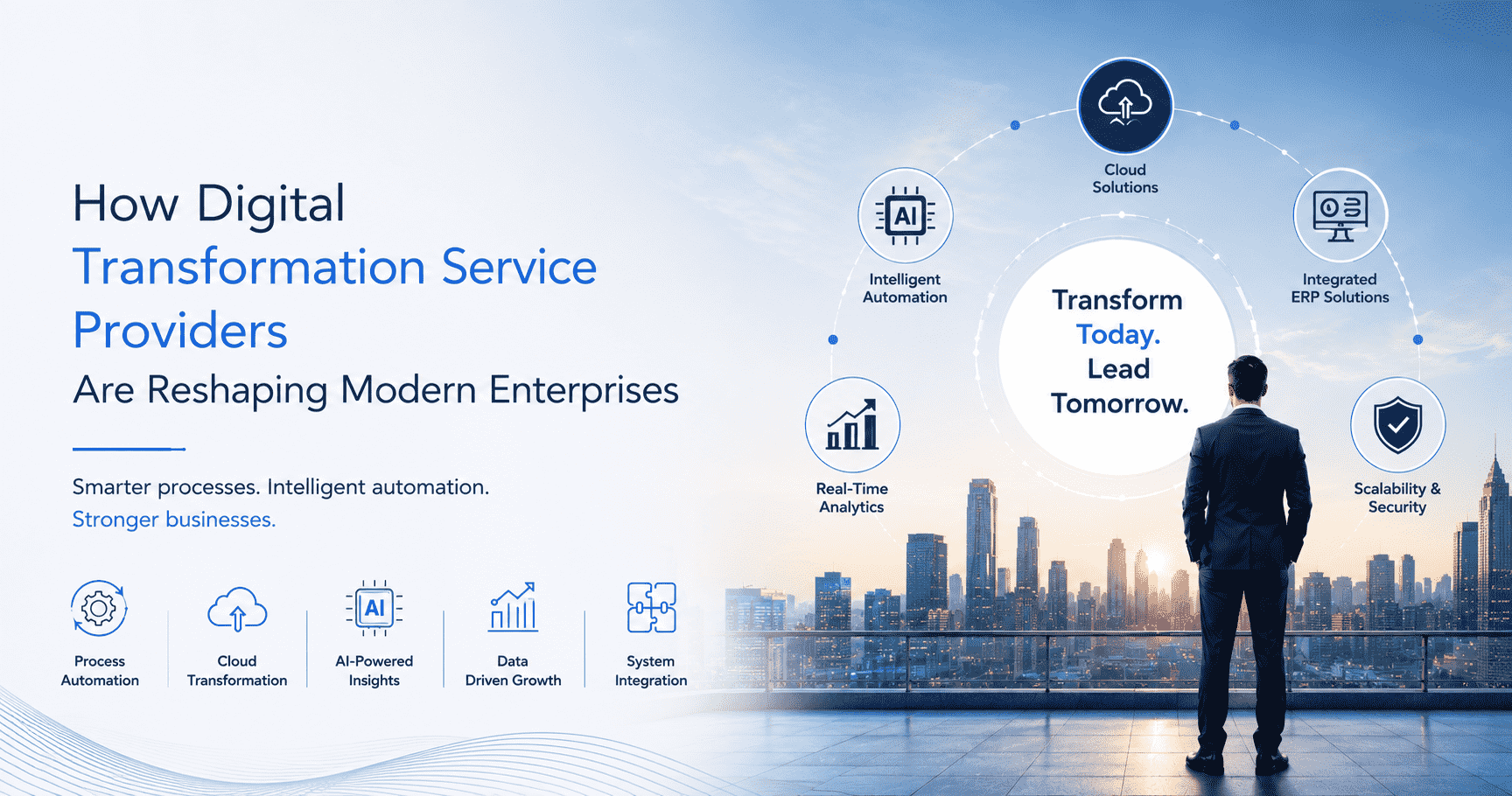
Digital transformation services: Enabling smarter, Faster, and More connected enterprises
The business landscape is evolving faster than ever. Organizations across industries face growing pressure to improve operational efficiency, enhance customer experiences, and make data-driven decisions.
As a result, digital transformation services have become a strategic priority for modern enterprises seeking sustainable growth and long-term competitiveness.
Key takeaway:
Digital transformation goes beyond technology adoption—
it requires reimagining processes,
integrating intelligent automation,
and building a connected enterprise ecosystem.
What are digital transformation services?
Digital transformation services include a broad set of solutions designed to modernize business operations, technology infrastructure, and workflows.
These services leverage digital technologies to improve efficiency, agility, scalability, and customer engagement.
Common digital transformation initiatives include:
- Business process automation
- ERP implementation and modernization
- Cloud migration
- AI and machine learning integration
- Data analytics and business intelligence
- Customer experience enhancement
- Legacy system modernization
- Workflow digitization
The goal is to create a digitally connected enterprise where information flows seamlessly across departments, enabling faster decision-making and improved performance.
Why modern enterprises need digital transformation
Traditional business processes often rely on manual data entry, disconnected systems, paper-based workflows, and delayed reporting.
These limitations slow growth and reduce operational visibility.
Real-time business insights
Organizations need immediate access to accurate and unified business data. Digital transformation solutions centralize information across functions, allowing leaders to make informed decisions quickly.
Increased operational efficiency
Automation eliminates repetitive manual tasks, reduces errors, and improves productivity across departments.
Better customer experiences
Customers expect faster responses, personalized interactions, and seamless service delivery. Digital technologies help businesses meet and exceed these expectations.
Greater business agility
Digitally enabled organizations can adapt faster to market changes, launch new services, and respond efficiently to evolving customer demands.
How digital transformation service providers create value
Digital transformation providers act as strategic partners, helping organizations identify inefficiencies, design transformation roadmaps, and deliver measurable outcomes.
Business process automation
One of the most impactful contributions of digital transformation services is automating routine business processes such as:
- Procurement
- Order management
- Inventory tracking
- Document approvals
- Financial reporting
- Customer support workflows
Automation reduces manual effort, lowers operational costs, and improves accuracy.
ERP-driven digital transformation
Enterprise Resource Planning (ERP) systems form the backbone of digital transformation initiatives.
Modern ERP platforms integrate finance, inventory, procurement, sales, customer management, and supply chain operations into a unified system.
This eliminates data silos and creates a single source of truth for decision-makers.
AI-powered decision-making
Artificial Intelligence enables predictive insights and intelligent automation across the enterprise.
Digital transformation services apply AI to:
- Demand forecasting
- Predictive maintenance
- Customer behavior analysis
- Inventory optimization
- Risk management
- Financial forecasting
Legacy system modernization
Many enterprises still rely on outdated systems that limit scalability and innovation.
Digital transformation providers modernize legacy environments through cloud migration, application modernization, system integration, and phased upgrades that minimize operational disruption.
Enhanced data visibility
By integrating business applications, digital transformation services enable:
- Real-time reporting
- Unified dashboards
- Advanced analytics
- KPI monitoring
- Performance tracking
Key technologies driving digital transformation
- Artificial Intelligence (AI): Automates decisions and improves forecasting
- Robotic Process Automation (RPA): Eliminates repetitive manual tasks
- Cloud Computing: Enables scalability and flexibility
- Advanced Analytics: Converts data into actionable insights
- ERP Platforms: Unify and manage core business operations
Benefits of partnering with a digital transformation provider
- Improved productivity and efficiency
- Reduced operational costs
- Faster and more accurate decision-making
- Enhanced customer satisfaction
- Scalability to support business growth
- Stronger competitive advantage
The future of digital transformation
Digital transformation continues to evolve as technologies advance.
Emerging trends include hyperautomation, AI-driven business operations, predictive analytics, intelligent ERP systems, digital supply chains, and low-code platforms.
Organizations that invest early in these capabilities will be better positioned to compete in the digital economy.
Why Axiever is a trusted digital transformation partner
At we help organizations accelerate digital transformation through AI-powered ERP and intelligent business automation.
Axiever enables enterprises to:
- Automate critical workflows
- Improve operational visibility
- Manage finance, inventory, procurement, and customer operations from one platform
- Eliminate manual processes
- Enable real-time, data-driven decision-making
- Support scalable and sustainable growth
Conclusion
Digital transformation service providers are reshaping modern enterprises by helping organizations streamline operations, improve customer experiences, and unlock the value of data and automation.
As competition intensifies and customer expectations rise, investing in digital transformation is no longer optional.
With intelligent automation, AI-powered ERP, and integrated business management, Axiever empowers organizations to become more agile, efficient, and future-ready.