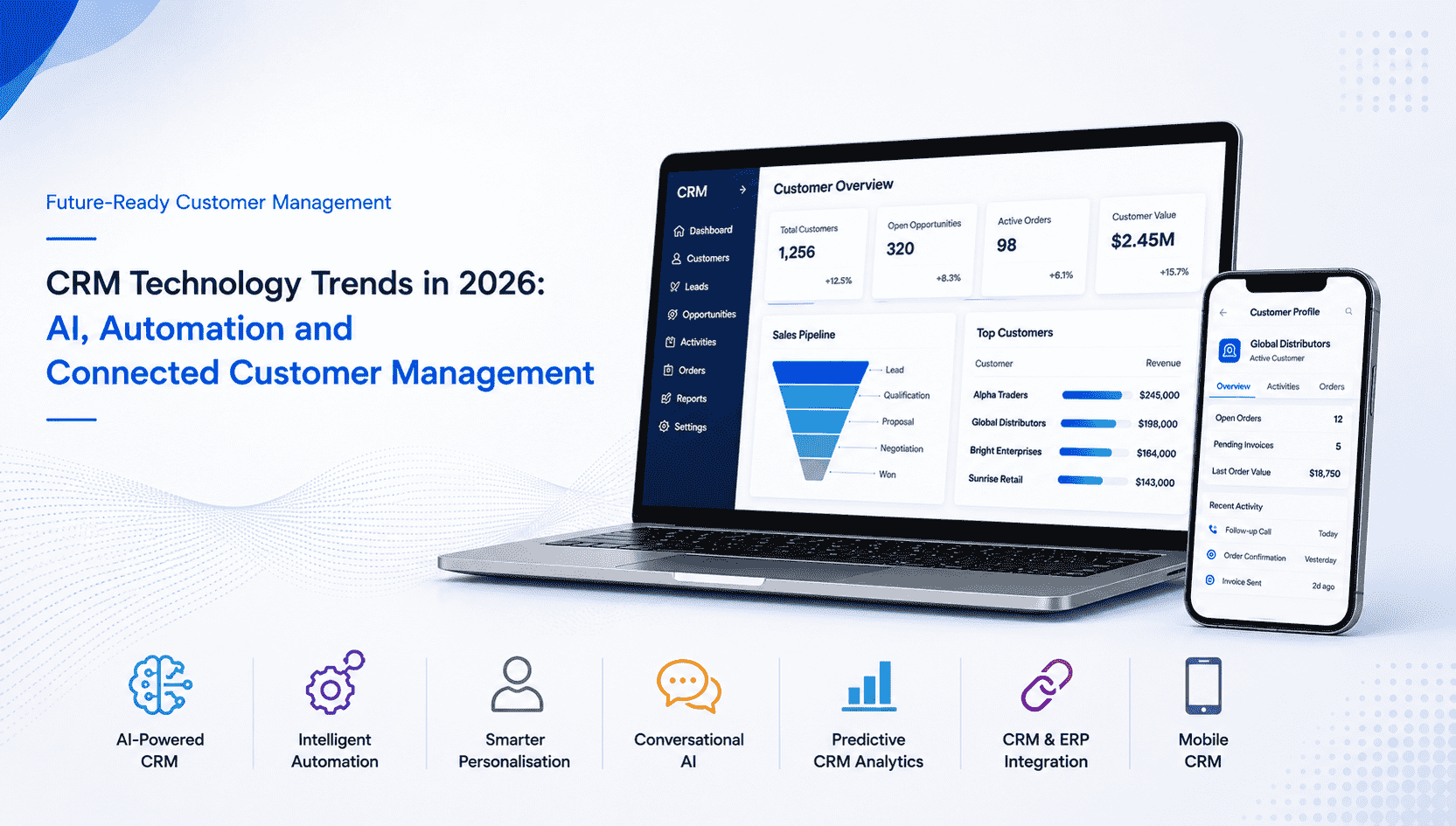
CRM technology trends in 2026: AI, automation and connected customer management
Customer relationship management is evolving beyond contact lists, sales pipelines, and customer records. The latest CRM technology trends are bringing artificial intelligence, automation, predictive analytics, conversational AI, mobile access, and connected business data into everyday customer management.
For modern businesses, CRM is becoming less about simply recording customer activity and more about helping teams understand what customers need, what action should happen next, and how customer relationships connect with wider business operations.
For trading and distribution companies, this shift is particularly important because customer management is closely connected with quotations, inventory, suppliers, orders, deliveries, invoices, and payments.
Why CRM technology trends matter in 2026
Customers expect faster responses, accurate information, personalised communication, and consistent service. At the same time, businesses are dealing with growing amounts of customer and transaction data.
The challenge is no longer collecting information. It is turning that information into action.
Modern CRM technology can help businesses:
- Automate repetitive sales activities
- Understand customer behaviour
- Prioritise opportunities
- Improve sales forecasting
- Personalise customer interactions
- Connect sales with operations
- Provide real-time customer information
- Reduce manual data entry
The result is a shift from CRM as a system of record to CRM as a system of action.
7 CRM technology trends businesses should watch
1. AI-powered CRM
Artificial intelligence is one of the biggest developments in CRM. Instead of simply storing customer information, AI can analyse customer interactions, purchase history, sales activity, and account behaviour to identify useful patterns. AI-powered tools can help sales teams summarise customer histories, prepare for meetings, identify opportunities, draft follow-ups, and recommend next steps. The objective is simple: less time searching for information and more time acting on it.
2. Intelligent CRM automation
Sales teams often spend valuable time updating records, assigning leads, scheduling follow-ups, changing statuses, and communicating information between departments. Automation can connect these activities into structured workflows.
For example: Lead → Qualification → Customer → Quotation → Order → Delivery → Invoice → Follow-up
When routine actions happen automatically, businesses can reduce administrative work while maintaining more consistent processes. This makes automation one of the most practical CRM technology trends for growing organisations.
3. Smarter customer personalisation
Personalisation is moving beyond simply using a customer's name in an email. Modern CRM systems can use purchase history, customer preferences, engagement, transaction frequency, and product interests to create a more complete customer profile. For a trading business, this could help identify customers who regularly purchase particular products and create more relevant sales opportunities. Instead of treating every customer identically, businesses can make interactions more relevant and timely.
4. Conversational AI
Conversational AI is changing how employees interact with business information. Instead of navigating several screens, a salesperson could ask: “What did this customer purchase recently?” A manager could ask: “Which opportunities need attention this week?” AI-driven conversational interfaces can make customer information easier to access while helping teams summarise interactions and identify next steps. The value is not simply having a chatbot. It is making business information easier to use.
5. Predictive CRM analytics
Traditional CRM reports mainly explain what already happened. Predictive analytics focuses on what could happen next. AI-powered analytics can help identify patterns around customer engagement, purchase behaviour, sales opportunities, account activity, and potential churn. For example, if a customer's purchasing frequency begins to change, a business may be able to identify the trend early and follow up before the relationship weakens. This moves businesses from reactive customer management to proactive customer engagement.
6. CRM and ERP integration
One of the most important CRM technology trends is the growing connection between CRM and ERP. Customer information may exist in CRM, while inventory, suppliers, orders, and finance are managed elsewhere. Consider a customer asking: “Can you supply 500 units next week?” The salesperson needs more than customer details. They may need to check inventory, supplier availability, existing commitments, pricing, delivery schedules, and financial information. When CRM and ERP work together, sales teams can access a broader business context before making commitments. For trading and distribution businesses, this connected approach can improve coordination between sales, inventory, procurement, operations, and finance.
7. Mobile CRM
Sales and service teams increasingly work outside the office. Mobile CRM allows employees to access customer profiles, sales activities, follow-ups, orders, and other information while visiting customers or working remotely. The benefit is simple: employees can access the information they need when they need it.
How Axiever applies these CRM technology trends
Axiever takes a connected approach to customer management by bringing CRM capabilities together with wider business operations.
Its customer module can work alongside functions such as:
- Order management
- Inventory management
- Supplier management
- Finance
- Document management
- Reporting
- Business automation
This is particularly valuable for trading and distribution businesses where customer relationships directly influence inventory, purchasing, sales orders, deliveries, and financial transactions. Instead of keeping customer information isolated, businesses can create a more connected flow of information across their operations.
Customer → Sales → Inventory → Supplier → Order → Delivery → Finance
That connected approach turns CRM from a standalone sales tool into part of a broader business-management environment.
The future of CRM is connected
The latest CRM technology trends show that customer management is becoming more intelligent, automated, and connected. AI can interpret information. Automation can move processes forward. Predictive analytics can identify opportunities. Conversational AI can simplify access to information. CRM-ERP integration can connect customer activity with business execution.
For growing businesses, the goal should not be adding more disconnected software. It should be creating a connected environment where customer information and operational processes work together.
Ready to connect customer management with your wider business operations? Explore Axiever and discover a smarter approach to integrated business management.