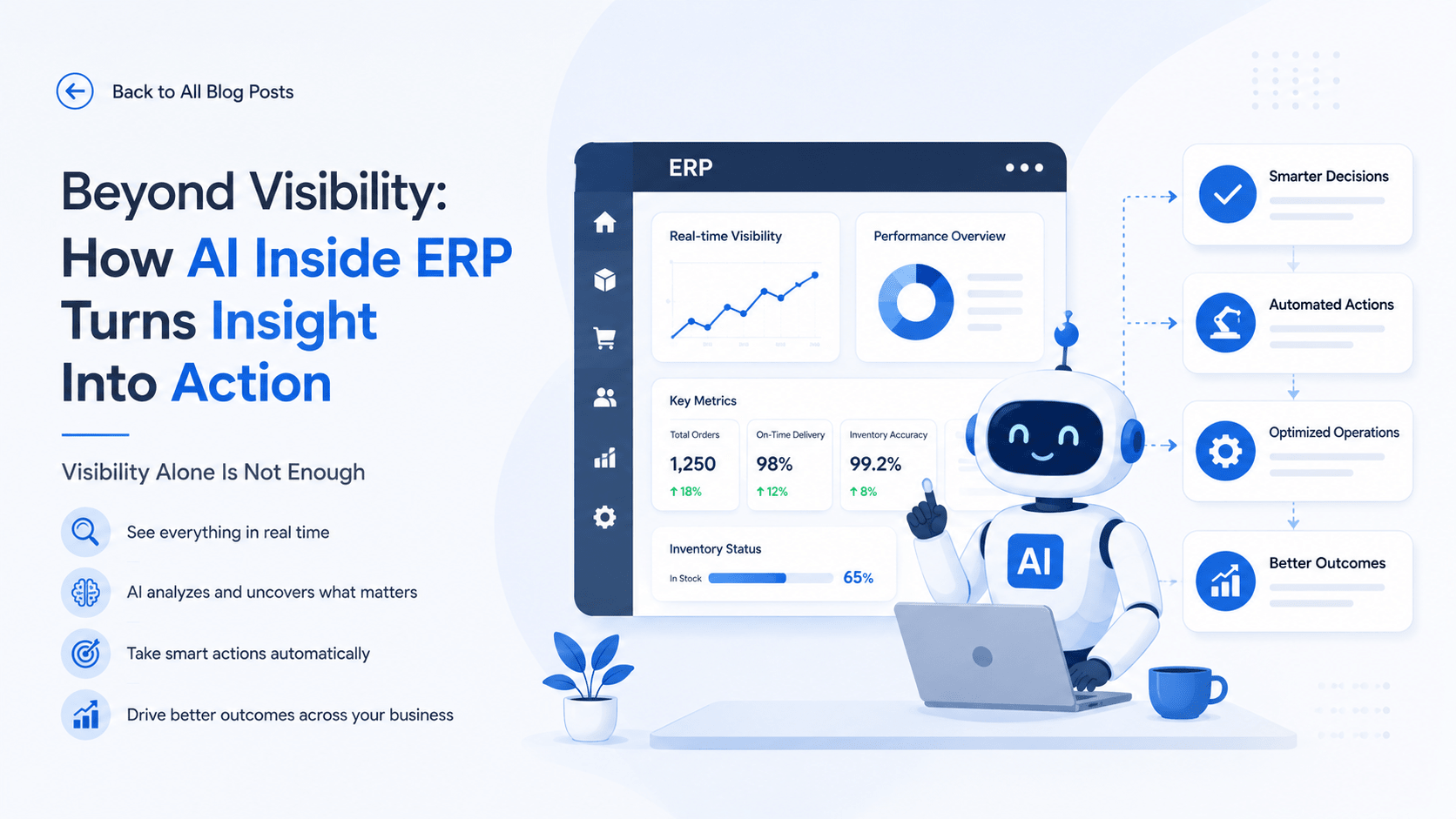
Beyond visibility: How AI inside ERP turns insight into Action
Visibility alone is not enough
Today, businesses have access to more data than ever before. Cloud software, analytics tools, IoT devices, and connected systems provide real-time visibility into inventory, sales, finance, employees, procurement, and operations.
While this level of visibility is valuable, it does not automatically solve business problems.
Many organizations still face disconnected systems, manual processes, delayed approvals, and slow decision making. Teams can see the data, but turning that information into timely action remains a challenge.
Reality check:
Data visibility without action creates insight—but not impact.
Why traditional ERP systems fall short
Traditional ERP platforms are designed to store, organize, and report business information. They provide dashboards and historical reports, but they rely heavily on human intervention to interpret data and decide next steps.
As businesses scale, this manual approach becomes slower and more complex. Decision making delays increase, and operational risks grow.
Impact:
Manual analysis does not scale with business complexity.
The shift toward AI-powered ERP
This is why businesses are moving toward AI-powered ERP systems. AI embedded directly inside ERP goes beyond reporting it helps businesses understand patterns, predict risks, and recommend actions.
Instead of only showing what happened, AI-powered ERP helps businesses determine what should happen next.
Result:
Faster insights lead to faster, smarter actions.
How AI inside ERP turns insight into action
When AI is built into ERP software, it connects data across departments and analyzes it in real time.
For example, in the case of a supply chain delay, a traditional ERP system may only trigger an alert. Teams then manually review inventory, suppliers, production schedules, and financial impact.
An AI-powered ERP system can analyze all of this data together, highlight risks, and support faster corrective action—reducing delays and improving efficiency.
Outcome:
Automated intelligence reduces response time across operations.
How Axiever uses AI inside ERP
:contentReference[oaicite:0]{index=0} delivers AI-powered ERP solutions designed to help businesses connect operations, automate workflows, and improve decision-making from one centralized platform.
By combining ERP, AI, and automation, Axiever reduces dependency on manual work across finance, HR, inventory, procurement, CRM, and core business operations.
Advantage:
One intelligent system replaces fragmented decision-making.
What AI-powered ERP enables
AI inside ERP helps businesses move from reactive management to proactive control.
- Improved operational efficiency
- Automation of repetitive tasks
- Reduced manual errors
- Smarter inventory management
- Stronger financial planning and forecasting
- Early detection of operational risks
- Better workflow coordination
- Faster and more confident business decisions
Business impact:
Intelligence-driven workflows replace manual decision bottlenecks.
The future of ERP
ERP is no longer just a system for storing business data. Modern ERP platforms are evolving into intelligent operating systems for the entire organization.
The future of ERP is not only about visibility. It is about converting insight into real, measurable action.
Final takeaway:
Visibility shows the problem. AI-powered ERP helps solve it.