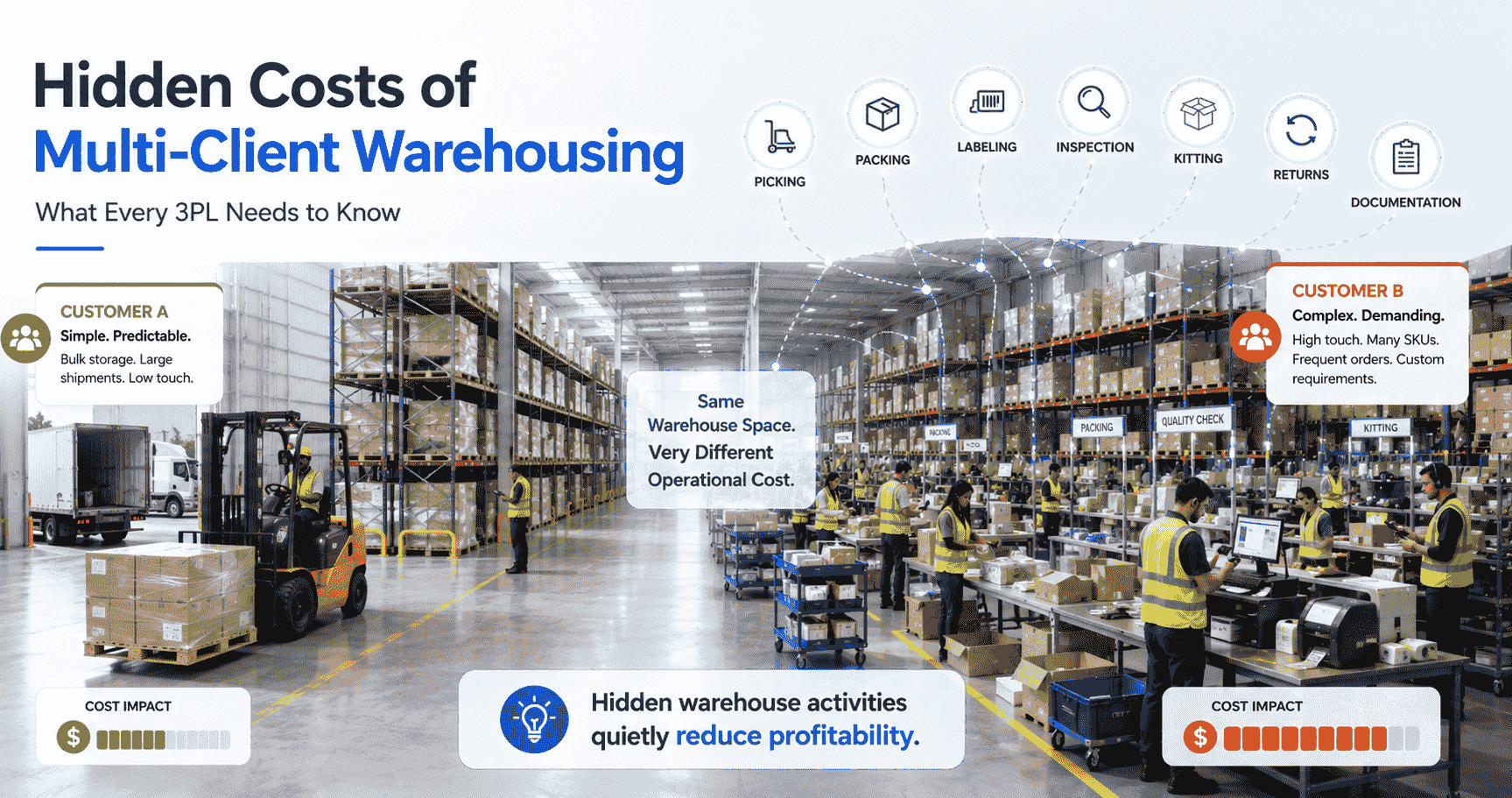
Hidden costs of multi-client warehousing: What every third-party logistics provider needs to know
Multi-client warehousing has become a popular operating model for third-party logistics providers (3PLs). By managing inventory for multiple customers under one roof, logistics companies can make better use of warehouse space, labor, equipment, and technology.
This approach helps reduce operating costs while improving flexibility and resource utilization. However, focusing only on warehouse occupancy and order volumes does not always reveal the full picture.
Key takeaway:
High warehouse utilization does not automatically translate
into high profitability—
hidden operational costs can quietly erode margins.
Why high occupancy doesn’t always mean higher profits
A warehouse operating near full capacity may appear successful on paper. However, not every customer consumes warehouse resources in the same way.
One customer may store inventory in bulk and ship large pallet orders weekly. Another may require daily order picking, custom packaging, labeling, and expedited shipping. Even if both occupy similar space, their operational impact is very different.
This is where the hidden costs of multi-client warehousing emerge. If labor-intensive activities are not accurately tracked and billed, profitability can decline without obvious warning signs.
Common hidden costs in multi-client warehousing
Several factors contribute to cost leakage and reduced efficiency in shared warehouse environments.
Complex order processing
Customers with high SKU counts, small order quantities, or frequent order changes require more picking and packing activity.
This increases labor requirements and can slow down warehouse operations, especially during peak periods.
Value-added services
Many customers request services beyond basic storage and shipping, including:
- Product labeling
- Kitting and assembly
- Repackaging
- Quality inspections
- Compliance documentation
While these services add customer value, they also consume labor, space, and time. If not properly tracked and billed, they become hidden drains on profitability.
Inventory movement patterns
Fast-moving inventory requires frequent replenishment, handling, and outbound activity. Slow-moving inventory, on the other hand, occupies valuable space for extended periods.
Both scenarios create costs that must be considered when evaluating customer profitability.
Customer-specific requirements
Some customers require customized reporting, dedicated support, priority order processing, or specialized workflows.
These requirements increase operational complexity and often demand additional resources to manage effectively.
Why cost-to-serve analysis matters
One of the most effective ways to uncover hidden costs is through cost-to-serve (CTS) analysis.
Cost-to-serve evaluates the true expense of supporting each customer, considering labor, storage, equipment usage, administration, and value-added services— not just revenue.
With cost-to-serve visibility, logistics providers can:
- Identify the most profitable customers
- Understand which services consume the most resources
- Improve pricing strategies
- Allocate resources more effectively
- Reduce operational inefficiencies
How technology improves cost visibility
Modern Warehouse Management Systems (WMS) and Enterprise Resource Planning (ERP) platforms help uncover hidden costs through real-time operational visibility.
Activity-based costing
Activity-based costing assigns expenses to specific warehouse tasks such as receiving, put-away, storage, picking, packing, and shipping.
This creates a more accurate view of customer-level profitability.
Real-time analytics
Dashboards and reporting tools allow managers to monitor labor productivity, warehouse performance, and resource utilization in real time.
Automated billing
Automated billing ensures that customer-specific services and value-added activities are accurately captured and charged, reducing revenue leakage.
Customer profitability insights
Detailed reporting highlights which customer accounts generate strong returns and which may require pricing or service adjustments.
How Axiever helps
At :contentReference[oaicite:0]{index=0}, we help logistics providers gain operational clarity through advanced ERP, WMS, analytics, and automation solutions.
Our technology enables organizations to track warehouse activities accurately, monitor resource utilization, and measure true customer profitability— helping reduce margin leakage and support smarter decision-making.
Conclusion
Multi-client warehousing offers clear advantages, including better resource utilization and lower operating costs. However, profitability depends on understanding what truly drives cost at the customer level.
By identifying the hidden costs of multi-client warehousing and adopting cost-to-serve analysis supported by modern warehouse technology, third-party logistics providers can improve efficiency, protect margins, and build a more scalable, profitable operation.