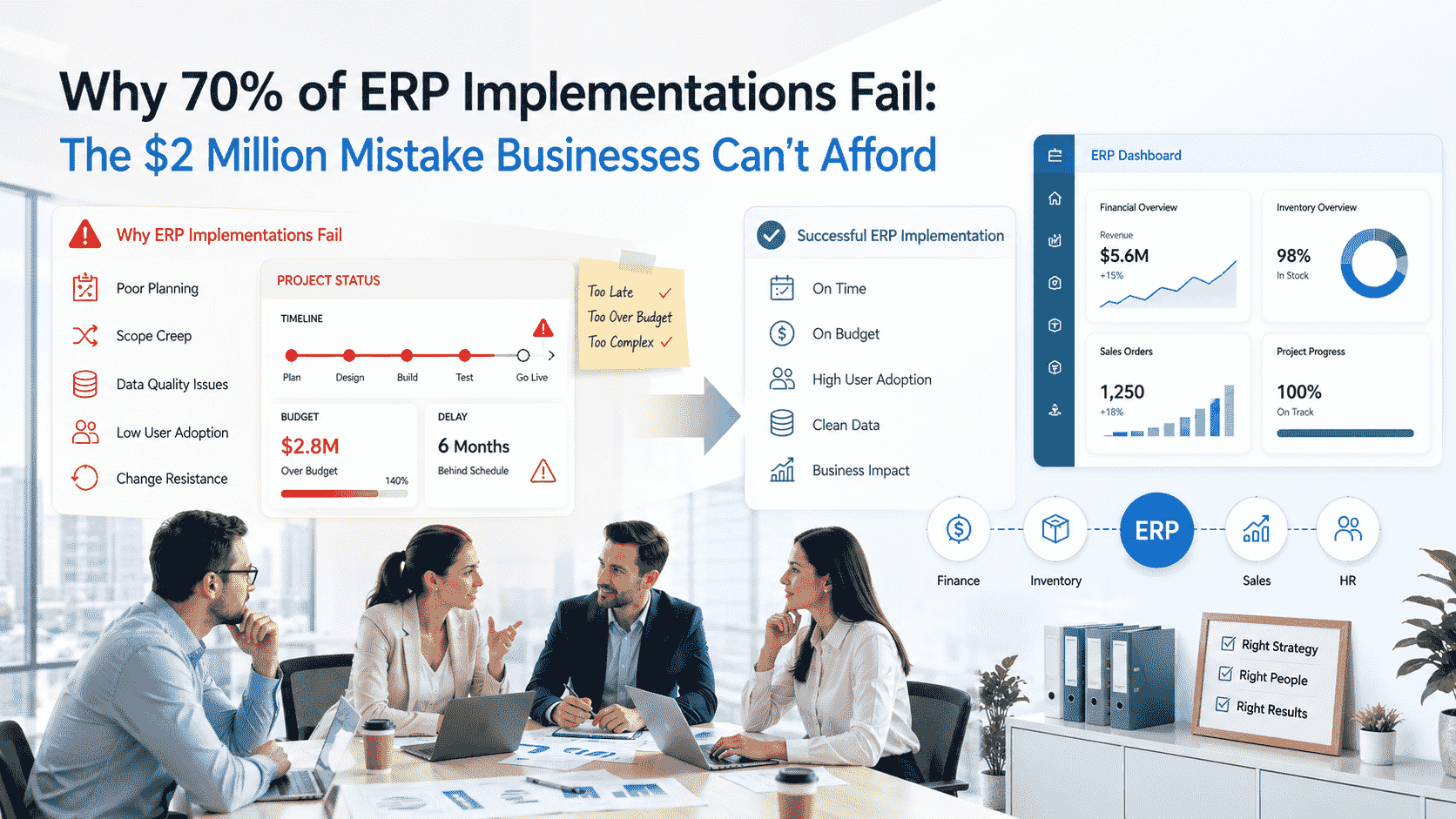
Why 70% of ERP implementations fail: The $2 million mistake businesses can't afford
ERP systems are designed to improve efficiency, increase visibility, and support business growth. However, many ERP implementations fail to achieve their intended outcomes. Delays, budget overruns, and low user adoption continue to challenge organizations across industries.
The good news is that most ERP failures are preventable. Understanding the common causes behind unsuccessful ERP projects can help businesses protect their investment and achieve long-term success.
Key takeaway:
ERP failures are rarely caused by technology alone
they are usually the result of poor planning,
weak execution,
and lack of alignment.
The hidden cost of ERP failure
A failed ERP project impacts far more than the IT department. It disrupts daily operations, reduces employee productivity, affects customer service, and delays strategic initiatives.
When implementation costs, lost productivity, rework, and process inefficiencies are combined, businesses can face losses exceeding $2 million. This is why careful planning and disciplined execution are critical for ERP success.
Why ERP implementations fail
Unclear business objectives
Many organizations start ERP projects without clearly defined business goals. When teams focus on system features instead of business outcomes, projects often lose direction.
Clear objectives, measurable KPIs, and expected ROI should be established before implementation begins.
Poor change management
ERP implementation introduces new processes, roles, and responsibilities. Without proper communication and training, employees may resist change, leading to low adoption.
Successful organizations prepare users early and provide continuous support throughout the transition.
Inefficient processes
Technology cannot fix broken processes. Automating inefficient workflows often increases complexity and implementation costs.
Reviewing and optimizing processes before deployment significantly improves project outcomes.
Lack of executive sponsorship
Leadership involvement plays a major role in ERP success. Executive sponsors help align teams, secure resources, and remove obstacles.
Strong leadership ensures accountability throughout the project lifecycle.
Inadequate training
Employees must understand how to use the new system effectively. Organizations that invest in role-based training and ongoing support achieve faster adoption and better results.
Poor data quality
ERP systems rely on accurate data. Migrating duplicate, outdated, or inaccurate information leads to reporting errors and operational issues.
Data cleansing and validation should be prioritized before implementation.
Choosing the wrong implementation partner
Many failed ERP projects can be traced back to selecting a partner based solely on cost.
Experience, industry knowledge, and proven methodology are equally critical. The right partner reduces risk and accelerates business value.
Best practices for ERP success
Organizations can significantly improve ERP success rates by following a structured approach:
- Define clear business objectives
- Engage stakeholders early
- Optimize processes before deployment
- Prioritize data quality
- Invest in user training
- Establish strong executive sponsorship
- Work with experienced ERP consultants
These best practices help minimize risk while maximizing return on investment.
How Axiever helps
At :contentReference[oaicite:0]{index=0}, we understand that successful ERP implementations require more than technology. They require a strategy that aligns people, processes, and business goals.
Our team helps organizations assess requirements, implement ERP solutions, streamline operations, ensure data accuracy, and drive user adoption. By combining technical expertise with business insight, we help businesses achieve faster results and long-term value.
Conclusion
While many ERP projects struggle to meet expectations, failure is not inevitable. Organizations that focus on planning, process optimization, employee engagement, and expert guidance are far more likely to succeed.
The real $2 million mistake is approaching ERP implementations without a clear strategy. With the right preparation and the right partner, businesses can transform ERP investments into a foundation for growth, efficiency, and competitive advantage.