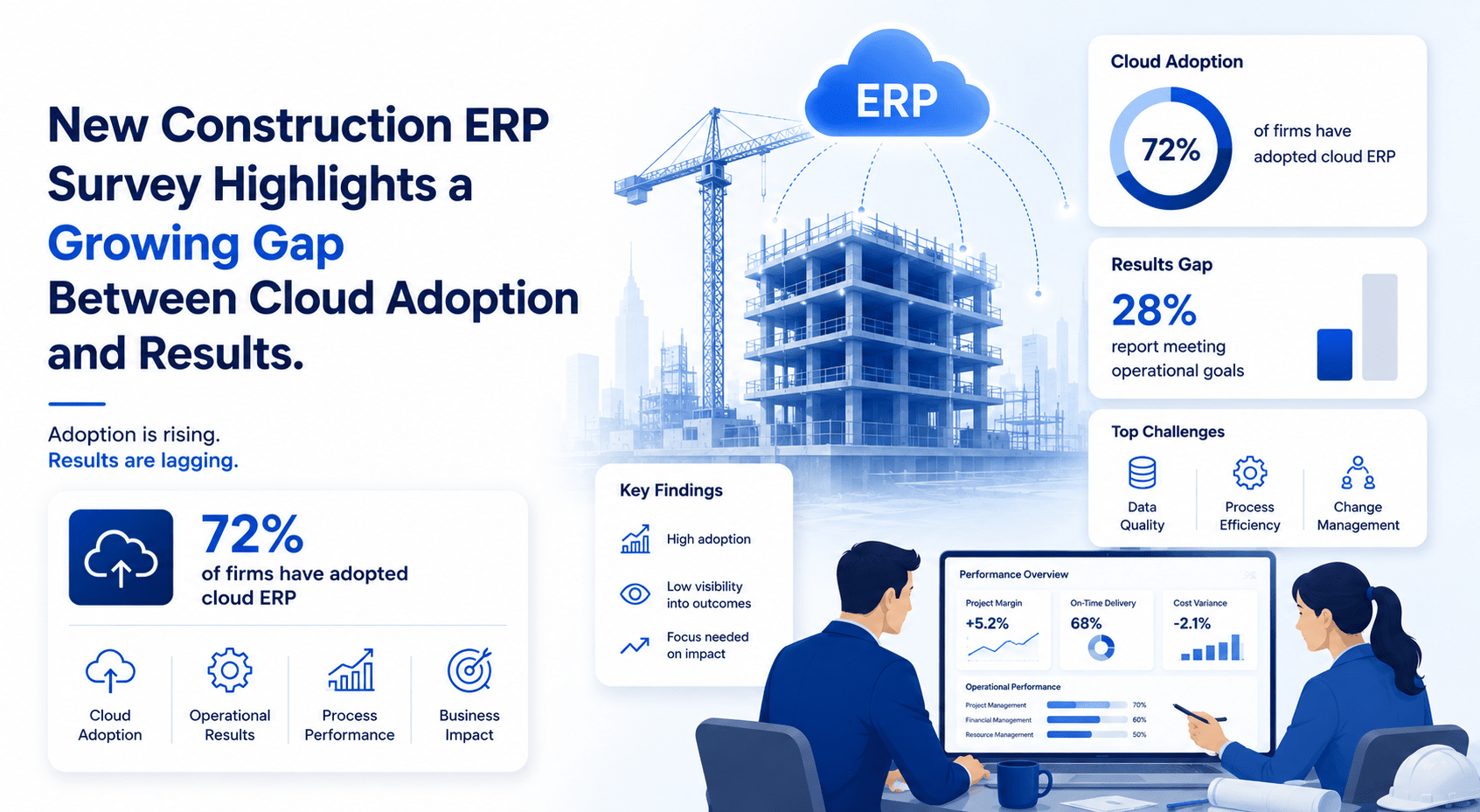
Construction ERP survey reveals the gap between cloud adoption and real results
Survey overview: construction ERP expectations are changing
A recent construction ERP survey highlights a growing realization across the industry: modern ERP systems must deliver more than basic digitization.
While cloud adoption is accelerating, construction businesses are becoming clearer about what ERP should actually improve—operational visibility, coordination, and decision-making across job sites and teams.
Key construction ERP survey findings
- Nearly 70% of respondents identified real time data access as a critical ERP requirement
- 42% cited limited mobile access as a major operational challenge
- 73% are already using cloud based construction ERP systems
- Project tracking, budget control, and software integration ranked as the highest-value ERP capabilities
At first glance, these numbers suggest progress. But the deeper insight tells a different story.
The cloud ERP gap: adoption Without transformation
Despite widespread cloud ERP adoption, many construction firms reported little to no improvement in:
- Project visibility
- Forecast accuracy
- Real-time decision-making
- Operational coordination
This reveals a critical industry gap: moving to the cloud alone does not resolve operational inefficiencies.
Cloud ERP adoption has become the baseline not the differentiator. Real value now depends on how deeply systems are integrated and how well they support day to day construction operations.
Why construction ERP still falls short in practice
Construction businesses do not operate from a single location. They operate across:
- Active job sites
- Procurement teams
- Finance departments
- Vendors and subcontractors
- Project managers
- Field operations
When ERP systems fail to connect these functions seamlessly, companies experience:
- Delayed reporting
- Limited field visibility
- Slower decision-making
- Budget overruns
- Fragmented communication
- Inconsistent project coordination
Mobile access remains a major weak point
The survey also highlights a persistent issue: incomplete mobile ERP accessibility.
While some firms enable full field access, many teams still operate with limited or no mobile ERP access during live site execution—creating a disconnect between on-site reality and management visibility.
Where construction ERP is headed
Despite current gaps, the industry shows strong alignment on the future direction of construction ERP:
- Real-time operational visibility
- Connected workflows across office and field
- Mobile-first ERP execution
- Integrated systems instead of isolated modules
- Faster coordination between teams
Another important signal from the survey is vendor flexibility. Many construction firms already using cloud ERP remain open to switching platforms—indicating that the market is still searching for better operational alignment and usability.
Final takeaway: cloud ERP is not enough
The construction ERP market is clearly evolving. Cloud adoption is now standard but transformation is not guaranteed.
Implementation quality, integration depth, user adoption, and real-world operational usability are now what determine whether ERP becomes a competitive advantage or just another system.