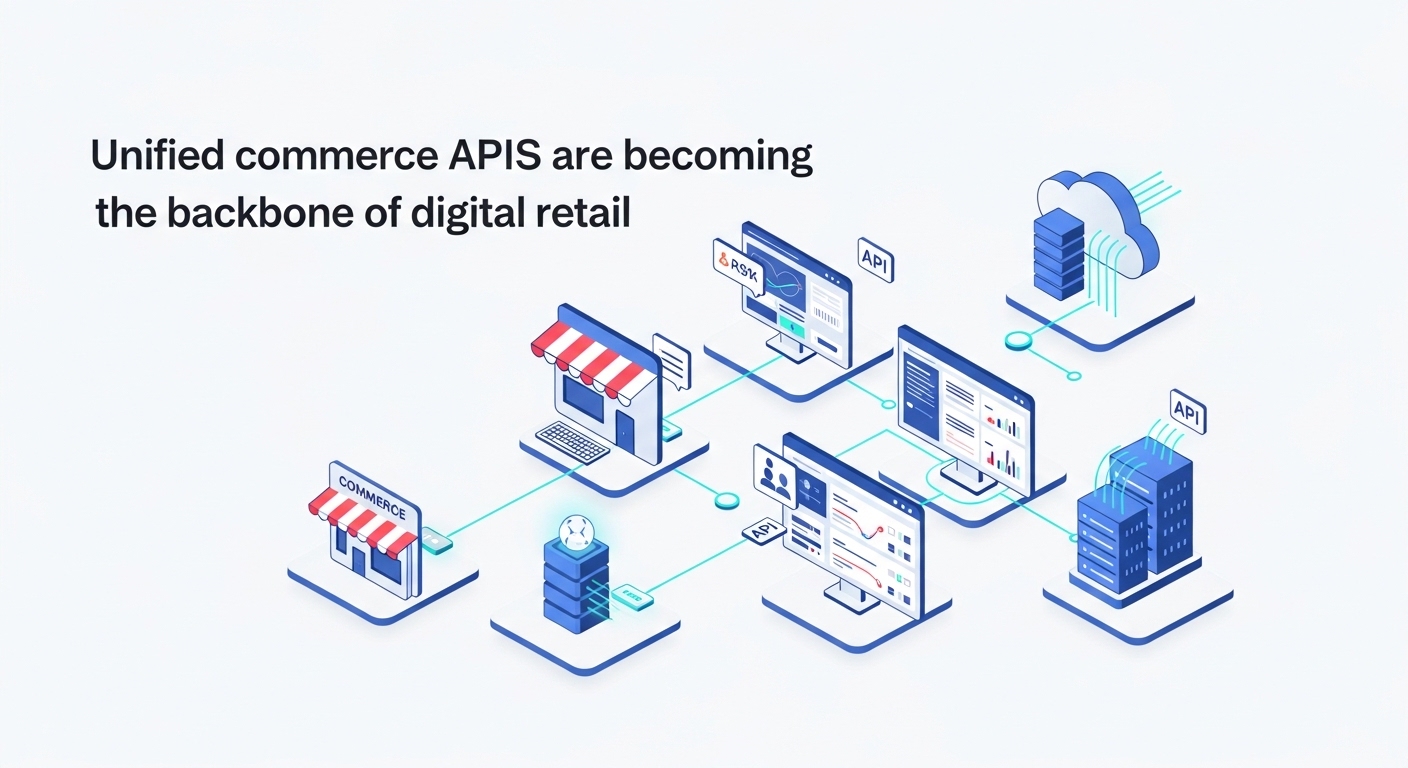
Unified commerce APIs are becoming the backbone of digital retail
Retailers adopting centralized API strategies are gaining scalability, efficiency, and operational clarity in 2026.
Retailers embracing unified commerce API strategies are reporting stronger scalability, improved operational efficiency, and lower technology maintenance costs in 2026.
As digital retail evolves, businesses are shifting away from fragmented system architectures toward unified commerce frameworks powered by centralized APIs.
These frameworks synchronize product, order, inventory, payment, and fulfillment data across online and offline channels within a single connected ecosystem.
Moving beyond fragmented integrations
For years, retailers relied on point to point integrations between e-commerce platforms, inventory systems, accounting tools, and logistics providers.
While functional, these architectures created complexity, increased maintenance effort, and limited scalability as new sales channels were added.
Unified commerce APIs replace this complexity with a centralized integration layer, enabling all systems to communicate through a single, consistent interface.
Real time data across every channel
A key advantage of unified commerce APIs is real-time data synchronization across all customer touchpoints.
Inventory updates, order statuses, returns, and financial adjustments are reflected instantly across online stores, marketplaces, physical locations, and backend systems.
- Centralized product information management
- Live order tracking across channels
- Unified customer profiles
- Automated fulfillment routing
- Accurate financial reporting
Analysts note that real time data consistency is becoming a competitive requirement rather than a technical enhancement.
Scalability and cost efficiency
Research indicates that retailers using unified API architectures scale more efficiently than those relying on isolated integrations.
New channels can be added without rebuilding infrastructure, significantly reducing long-term IT costs and deployment timelines.
Reduced complexity allows teams to focus on innovation instead of maintaining redundant system connections.
ERP and backend synchronization gains importance
Unified commerce APIs are strengthening the role of ERP systems within retail operations.
Rather than functioning as standalone accounting tools, ERP platforms are becoming deeply integrated components of commerce ecosystems.
API-first ERP solutions such as Axiever are enabling two way synchronization between retail channels and backend operations, supporting real time invoicing, tax compliance, procurement planning, and centralized financial dashboards.
A strategic shift for 2026 and beyond
As competition intensifies, unified commerce APIs are emerging as foundational retail infrastructure.
Businesses adopting centralized, API driven models are better positioned to expand into new markets, manage omnichannel complexity, and respond quickly to changing demand.
In 2026, unified commerce APIs are no longer a backend technical decision they are the backbone of modern digital retail strategy.