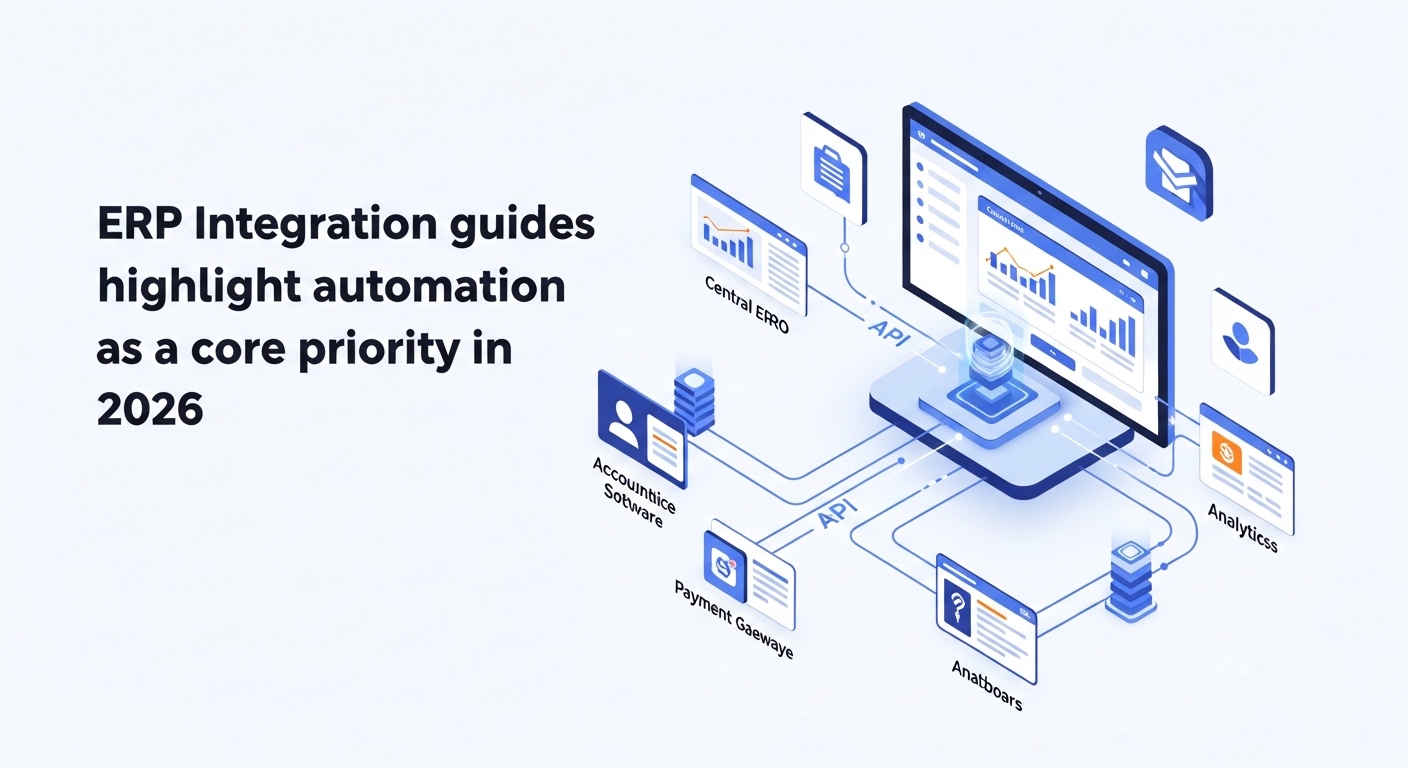
ERP integration guides highlight automation as a core priority in 2026
ERP connectivity has shifted from optional enhancement to essential infrastructure for ecommerce driven businesses.
Enterprise integration guides released throughout 2026 point to a clear conclusion: connecting ecommerce platforms with ERP systems is now a foundational requirement.
As online sales volumes grow across B2B and B2C sectors, businesses face increasing pressure to eliminate manual processes and reduce operational errors.
Disconnected ecommerce, finance, inventory, and procurement systems are creating inefficiencies that modern organizations can no longer sustain.
Automation moves to the center of strategy
Automation has become the primary driver behind ERP integration initiatives.
When ecommerce platforms connect directly with ERP systems, orders, pricing, inventory, tax calculations, and customer records synchronize automatically.
Integration guides highlight that automation reduces human intervention, improves data accuracy, and accelerates workflows across departments.
Eliminating costly manual re-entries
Manual data re-entry remains a major bottleneck for growing ecommerce businesses.
Each transfer of order information increases the risk of errors, delays, and missing details.
ERP integration eliminates duplication by allowing orders to flow instantly into finance, inventory, invoicing, and logistics workflows.
Real time inventory updates prevent overselling and reduce stock mismatches across channels.
Improving operational speed and fulfillment accuracy
Operational speed has become a competitive differentiator.
ERP integration ensures immediate updates across warehouses, procurement, and finance once an order is confirmed.
Platforms such as Axiever are prioritizing API driven ERP architectures to support real time ecommerce connectivity and scalable digital operations.
From enhancement to essential infrastructure
ERP integration is increasingly viewed as a business continuity and risk mitigation strategy.
Automated synchronization improves audit readiness, compliance reporting, and financial transparency.
Industry experts agree that ERP integration is no longer a technical upgrade it is core infrastructure for businesses operating in a digital first economy.
In 2026 and beyond, automation through ERP integration will remain central to scalability, efficiency, and long term competitiveness.