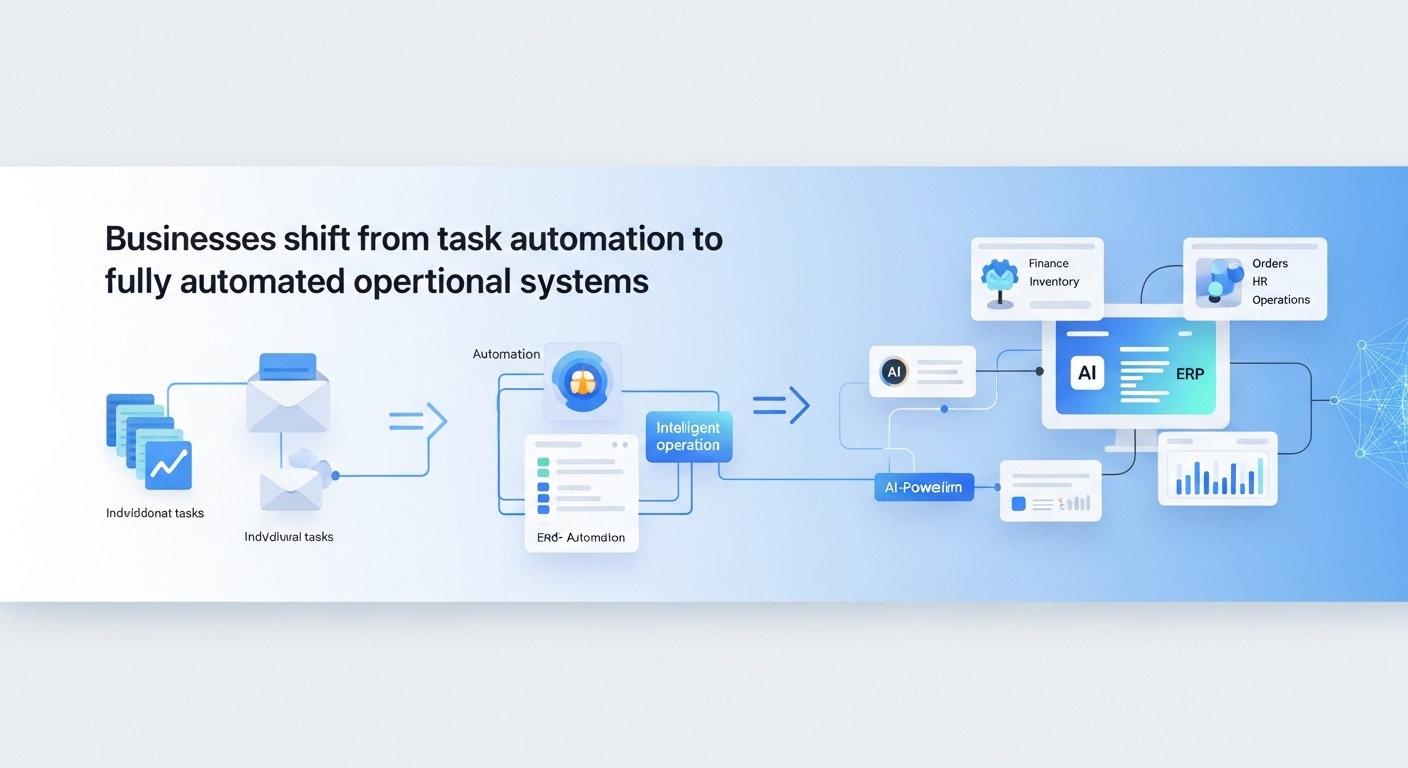
Businesses shift from task automation to fully automated operational systems
Organizations move beyond isolated task automation toward connected, end to end operational execution.
Businesses are increasingly adopting automation systems that manage complete operational processes rather than focusing solely on individual tasks.
Historically, automation handled isolated activities such as invoice generation, payment reminders, or report creation. While helpful, these tools still required human coordination between operational stages.
Employees needed to initiate follow-ups, verify completion, and move information across departments manually.
Shift toward connected operational automation
Enterprise technology providers are now introducing platforms designed to automate entire operational chains.
In these systems, when a business event occurs—such as a customer order subsequent actions like invoicing, financial posting, accounting updates, and reporting adjustments happen automatically.
This represents a shift from task level automation to system-level automation, where workflows continue without manual intervention.
Reducing operational friction and delays
A key driver behind this transition is the need to reduce operational friction.
Traditional workflows often slow down due to disconnected systems, manual handoffs, and delayed initiation of next steps.
System level automation enables workflows to move forward automatically, improving speed, consistency, and operational stability as organizations scale.
Enterprise platforms integrate automation across departments
Modern enterprise platforms connect core business functions such as sales, finance, inventory, and reporting into unified environments.
Platforms such as Axiever are designed around this integrated automation model, allowing operational processes to flow seamlessly across modules while keeping financial and operational data synchronized.
This integration also improves visibility, as data updates occur automatically across the system.
Automation becomes operational infrastructure
Analysts view system level automation as part of a broader evolution in enterprise technology.
Automation is no longer just a productivity aid. It is becoming part of the operational infrastructure that keeps businesses running efficiently.
By automating connected workflows, organizations reduce manual workload, improve execution reliability, and support scalable growth without increasing administrative complexity.
Automation is no longer limited to individual tasks. It is becoming foundational to how modern businesses operate.